Introduction
Your website is the first thing most customers see before they ever contact you or buy from you. And they make a decision about your business within seconds of landing on your page.
That decision is based almost entirely on web design. Most business owners build a website once, never touch it again, and wonder why it is not bringing in customers. Poor web design quietly costs businesses customers and revenue every single day — without the owner even realising it.
This guide is written specifically for business owners. No technical language. Just clear, honest information about what web design really is, why it matters, and what your business website needs to succeed.
Why Web Design Matters More Than You Think
Web design is not just about how your website looks. It is about how it works, how it makes visitors feel, and whether it convinces them to take action.
Visitors judge your website in milliseconds.
People form an opinion about a website within 0.05 seconds of landing on it. That opinion happens before a single word is read — based entirely on design.
Poor web design destroys trust.
If your website looks outdated or is confusing to navigate, visitors assume your business is unprofessional. They leave and go to a competitor — even if your product or service is actually better.
Good web design increases sales.
A well-designed website guides visitors naturally toward taking action — making a purchase, filling a contact form, or calling your number.
Your website never closes.
It represents your business 24 hours a day, 7 days a week. A poorly designed website is a 24-hour liability. A well-designed one is a 24-hour salesperson.
What Web Design Actually Includes
Many business owners think web design simply means picking colours and fonts. In reality, it covers everything that affects how a visitor experiences your website.
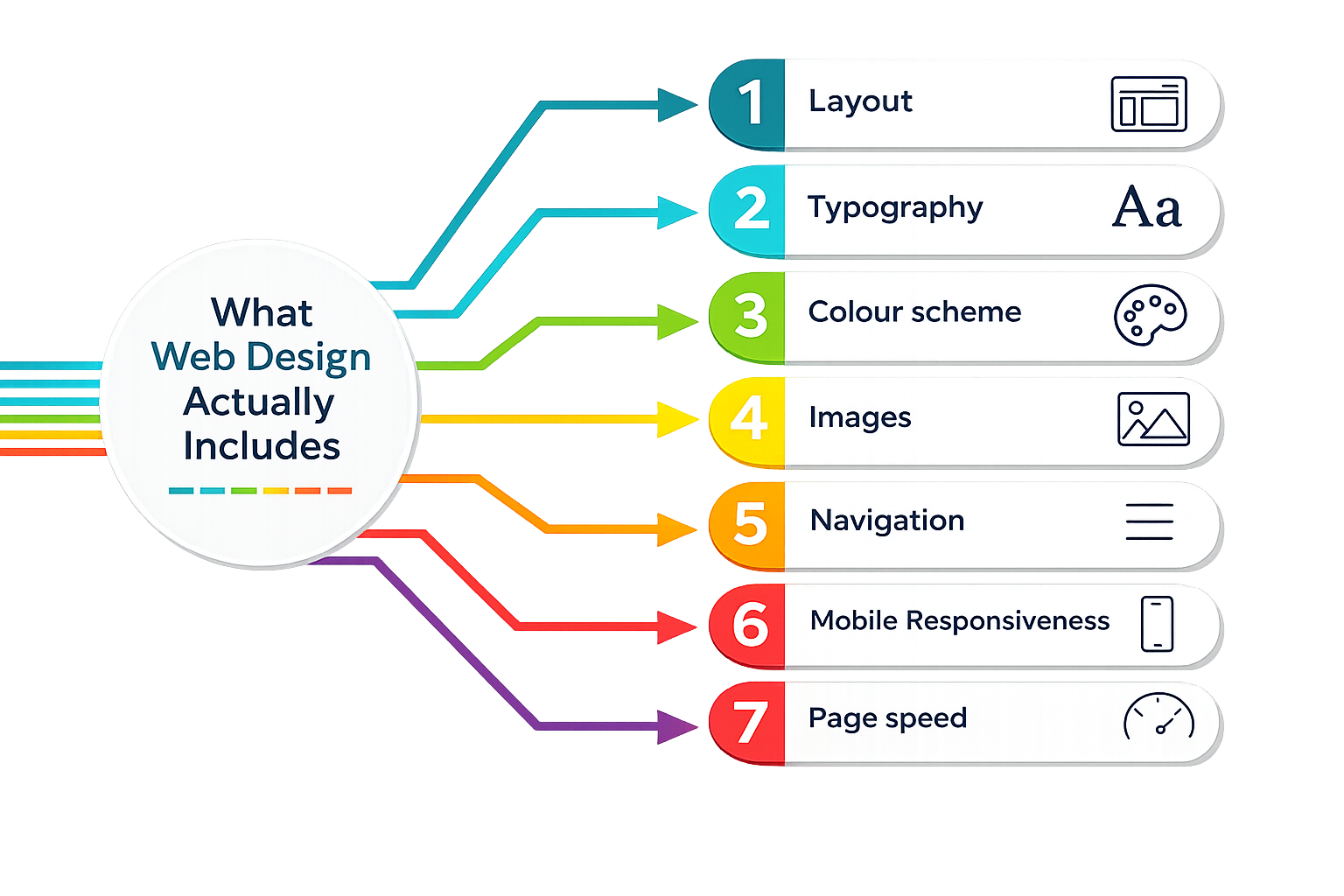
Layout
Layout is how content is arranged on the page. A good layout guides the visitor’s eye toward the most important information and the next step you want them to take.
Typography
Typography refers to the fonts and text size you use. Good typography makes your content easy to read. Poor typography makes visitors give up and leave.
Colour scheme
Colour scheme communicates your brand personality and affects how visitors feel. The right colours build trust. The wrong ones create confusion.
Images
Images communicate faster than words. High-quality, relevant images instantly make your website look professional. Low-quality images do the opposite.
Navigation
Navigation is how visitors move around your website. Clear, simple navigation helps people find what they need quickly. Confusing navigation frustrates visitors and causes them to leave.
Mobile responsiveness
Mobile Responsiveness means your website works perfectly on any device. More than half of all website visits happen on mobile phones. A website that does not work on mobile loses more than half its potential customers.
Page speed
Page speed is how fast your website loads. Visitors expect pages to load within two to three seconds. Every extra second of delay increases the number of people who leave before your page even appears.
The Most Important Pages Every Business Website Must Have
Every business website must have these core pages that visitors expect to find.
Home page
The home page must immediately communicate who you are, what you do, and what the visitor should do next. A confusing home page loses visitors within seconds.
About page
The About page tells the story of your business and why customers should trust you. People buy from people. A genuine page builds real connection and trust.
Services or products page
The services or product page explains what you offer and why it is valuable. Always write from the customer’s perspective — focus on the benefit they receive, not just what you provide.
Contact page
The contact page makes it easy for potential customers to reach you. Include your phone number, email, contact form, and address. Make it as simple as possible for someone to get in touch.
Testimonials page
The Testimonials page shows real feedback from real customers. This is one of the most powerful trust-building elements on any business website.
Common Web Design Mistakes Every Business Makes
These are the most common web design mistakes that cost businesses and customers every day.
Too much information on one page.
Cramming everything onto one page overwhelms visitors. Keep each page focused on one clear purpose.
No clear call to action.
Every page must have one visible next step — call us, book now, get a quote. Never leave visitors wondering what to do.
Using low-quality images.
Blurry or irrelevant images make a website look cheap and untrustworthy. Always use sharp, high-quality images.
Slow loading speed.
Every second of delay costs you, visitors. A fast website keeps people on your page. A slow one sends them to your competitor.
Not optimised for mobile.
A website that is hard to use on a phone immediately drives away the majority of your visitors.
Too many fonts and colours.
Stick to two fonts and two to three colours throughout your entire website for a clean, consistent, professional appearance.
No contact information visible.
Your phone number and email should be clearly visible on every single page of your website.
How Web Design Affects Your Search Rankings
Web design and search engine optimisation are closely connected. Google ranks websites based on the experience they provide to visitors — not just keywords.
Page speed is a ranking factor.
Slow websites rank lower. A fast website is essential for being found online.
Mobile-friendliness is a ranking factor.
Google primarily evaluates the mobile version of your website when determining search rankings. A mobile-friendly website can improve user experience, support SEO performance, and help your site rank more effectively in search results. A professional website design company in Coimbatore can help you build a responsive, mobile-optimized website that improves visibility and user engagement.
Time on site affects rankings.
When visitors stay longer because your website is easy to use, it signals to Google that your website is valuable — improving your rankings over time.
Bounce rate affects rankings.
If visitors leave immediately because your website loads slowly or looks poor, Google pushes your rankings down.
Simple Tips to Improve Your Business Website Right Now
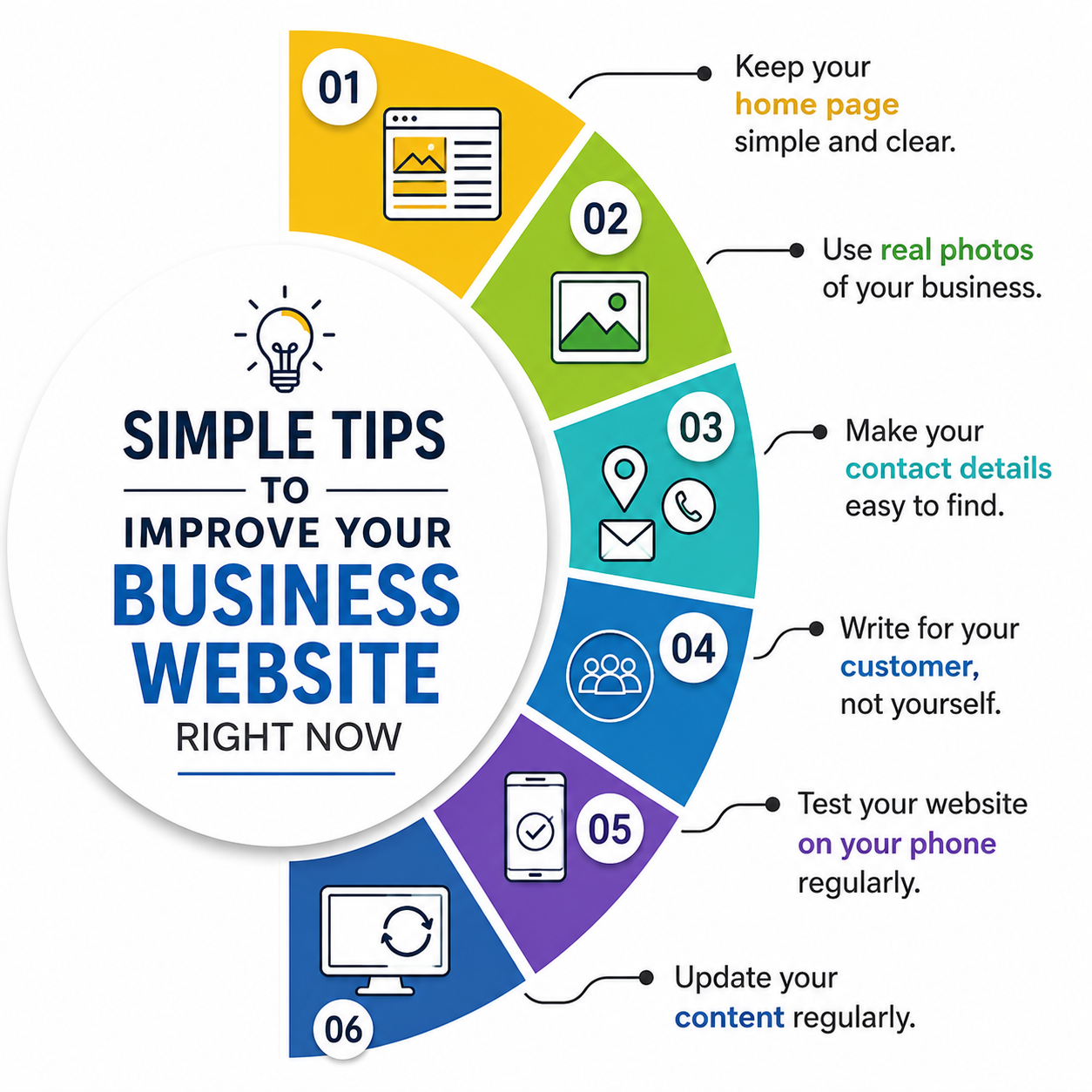
Keep your home page simple and clear.
Answer three questions immediately — who you are, what you do, and what the visitor should do next.
Use real photos of your business.
Real photos of your team, workspace, and products build far more trust than generic stock photos.
Make your contact details easy to find.
Put your phone number and email in the header of every page.
Write for your customer, not yourself.
Every word on your website should speak to your customer’s needs — not what sounds impressive about your business.
Test your website on your phone regularly.
Check for anything that is hard to read, slow to load, or difficult to tap. Fix it immediately.
Update your content regularly.
Keep your content updated regularly. Outdated information can make your business appear inactive and unreliable. Review your website every few months to ensure all content remains accurate, relevant, and fresh.
FAQ
1. My website looks outdated. Does it really matter?
Solution: Yes. An outdated website can reduce trust and make visitors leave. Refreshing your design, images, and layout can improve credibility and customer engagement.
2. Visitors come to my website but don’t contact me. Why?
Solution: Your website may lack clear calls-to-action. Add visible contact buttons, enquiry forms, and compelling messages that guide visitors toward taking action.
3. My website looks good on a computer but not on a phone. What should I do?
Solution: Implement responsive web design so your website automatically adapts to different screen sizes and provides a smooth mobile experience.
4. My website takes too long to load. How can I fix it?
Solution: Optimize images, reduce unnecessary plugins, use fast hosting, and enable caching to improve loading speed and user experience.
5. Customers say they can’t find information easily. What’s the problem?
Solution: Simplify your navigation menu and organize content logically so visitors can quickly find what they need.
6. My website doesn’t reflect my brand properly.
Solution: Use consistent colors, fonts, visuals, and messaging that align with your brand identity across every page.
7. I get website traffic, but sales remain low.
Solution: Improve your landing pages, strengthen your value proposition, and create a clear path for visitors to become customers.
Final Thought
Web design is not a luxury. It is one of the most important business tools you have.
Your website works for your business every hour of every day. It is where trust is built or lost in seconds. It is where visitors decide to contact you — or go to your competitor instead. Keep your website fast, clear, and focused on what your visitors need. Make sure it reflects the real quality of your business. A great website does not just look good. It works hard for your business — every single day.