Introduction
Every growing business eventually hits the same wall. Operations become harder to manage. Customer information gets lost. Teams work in silos. And customers who once felt valued start going elsewhere.
The problem is never the people. The problem is always the systems.
Understanding how ERP and CRM help businesses is one of the most important things any business owner can learn – because these two tools, working together, solve the exact problems that stop most businesses from growing the way they should.
What ERP Does – And Why Your Business Cannot Run Without It
ERP stands for Enterprise Resource Planning. It connects every department in your business – finance, inventory, purchasing, HR, and operations – into one unified system where everyone works from the same real-time data.
Without ERP, departments operate in isolation. Data gets duplicated. Errors multiply. Nobody has a complete picture of what is actually happening across the business.
With ERP, everything is connected. A sale updates inventory automatically. Low stock triggers a purchase order. An invoice raised is immediately visible to finance. Every team sees the same information – eliminating confusion and making the entire business run more efficiently every single day.
Why Every Customer-Facing Business Needs ERP and CRM
CRM stands for Customer Relationship Management. It stores, organises, and manages every interaction your business has with customers — from the first enquiry through to long-term repeat relationships.
Without CRM, customer information lives in inboxes, spreadsheets, and individual memories. Follow-ups get missed. Leads go cold. When a team member leaves, their relationships often leave with them.
With CRM, every customer interaction is recorded and accessible to the entire team. Every lead is tracked. Every follow-up is scheduled automatically. Every customer feels genuinely known and valued – regardless of who in the team they speak to.
How ERP and CRM Integration Improves Business Efficiency and Growth
ERP and CRM are powerful individually – but their true value is unlocked when they operate as one integrated system.
When connected, a sales team can see live inventory before promising a delivery date. A customer service team can check order status without calling the warehouse. A finance team can automatically flag overdue invoices to sales.
This eliminates the disconnect between what is promised to customers and what operations can actually deliver — one of the most expensive and damaging problems in any growing business.
Understanding how ERP and CRM work together means recognizing that great customer experiences are built on the foundation of excellent operations.
Common Business Problems and How ERP and CRM Fix Them
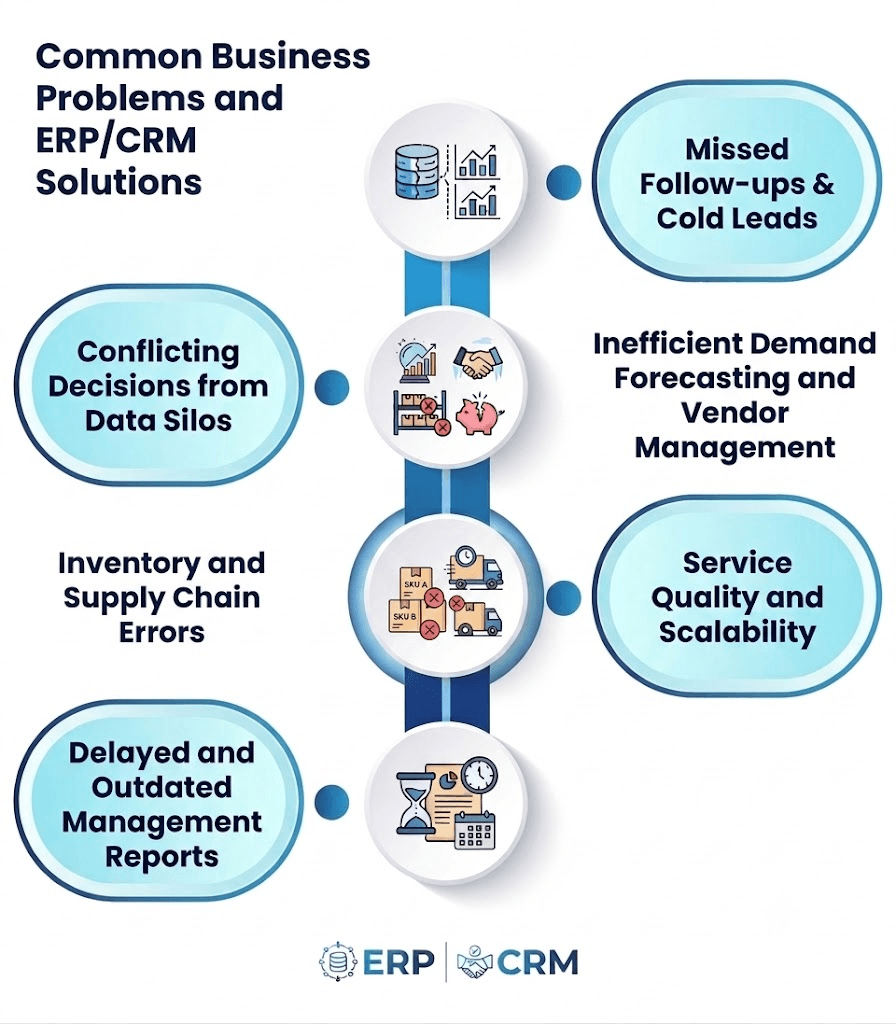
Teams are working from different data and making conflicting decisions.
ERP connects every department into one unified system – ensuring everyone works from the same accurate, real-time information always.
Customer follow-ups are being missed, and leads are going cold.
CRM automatically schedules every follow-up and tracks every lead — ensuring no opportunity is ever lost due to poor process or human error.
Inventory errors are damaging customer relationships and wasting money.
ERP tracks inventory in real time and triggers automatic reorder points — eliminating stockouts and fulfilment errors before they reach customers.
Customer service quality drops as the business and team grow busier.
CRM gives every team member instant access to complete customer history — enabling consistent and personalised service at any scale.
Management reports take too long and are outdated by the time they are ready.
ERP generates accurate real-time reports automatically — giving leadership the data they need to make fast and confident business decisions every day.
How ERP and CRM Support Business Growth at Every Stage
One of the most important things to understand about how ERP and CRM help businesses is that their value grows as the business grows.
At the early stage, they bring structure to a business outgrowing spreadsheets — allowing a small team to manage more customers, more orders, and more complexity than would otherwise be possible.
At the growth stage, they become the engine powering scalable expansion — new team members onboard faster, new customers are acquired confidently, and operations scale without chaos.
At the mature stage, they provide the data and analytics that enable strategic decision-making — identifying the most profitable products, the most valuable customers, and the operational bottlenecks limiting further growth.
What to Look for When Choosing ERP and CRM
Knowing how ERP and CRM help businesses is one thing — choosing the right tools is another.
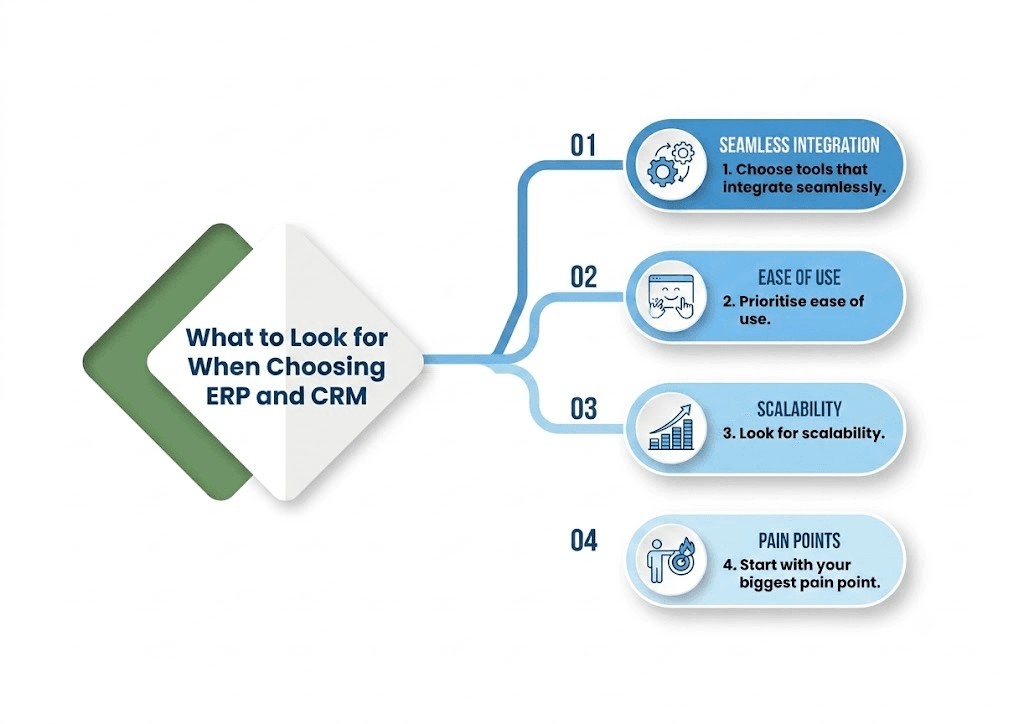
Choose tools that integrate seamlessly.
The full value of ERP and CRM is only unlocked when they share data in real time — either as one platform or through a proven integration.
Prioritise ease of use.
The best system is the one your team will actually use. Overly complex tools with steep learning curves get avoided — defeating the purpose entirely.
Look for scalability.
Choose systems that grow with your business. Switching later is expensive and disruptive — invest in tools built to serve you long term.
Start with your biggest pain point.
If customer management is your biggest problem, start with CRM. If operational chaos is your biggest problem, start with ERP. Get one right before adding the other.
FAQ
Q1. What is the difference between ERP and CRM?
ERP manages internal operations like inventory and finance while CRM manages customer relationships, sales pipelines, and customer communication.
Q2. Does a small business need both ERP and CRM?
Yes — ERP keeps operations organised while CRM ensures every customer relationship is managed consistently and effectively, regardless of team size.
Q3. How long does it take to implement ERP and CRM?
A basic implementation typically takes four to twelve weeks, depending on business complexity and the specific systems being deployed.
Q4. Will ERP and CRM replace my existing team?
No — they handle repetitive tasks, so your team can focus entirely on higher-value work requiring human judgment and genuine customer relationships.
Q5. How much do ERP and CRM cost for a small business?
Cloud-based solutions start from a few thousand rupees per month — making them accessible and affordable for businesses of all sizes and stages.
Q6. Can ERP and CRM work together in one system?
Yes — many modern platforms offer integrated ERP and CRM functionality, while others connect through APIs, allowing seamless real-time data sharing between the two.
Q7. How do I know if my business is ready for ERP and CRM?
If your team is managing data in spreadsheets, missing follow-ups, or struggling to maintain consistent customer service, your business needs ERP and CRM right now.
Conclusion
Understanding how ERP and CRM help businesses is about building efficient operations and stronger customer relationships. ERP streamlines internal processes, while CRM improves customer engagement and sales performance.
Start by addressing your biggest business challenge and implementing the right solution for long-term growth. If you’re searching for a trusted CRM software company in Coimbatore, choosing the right technology partner can help you maximize the benefits of both ERP and CRM systems. Ultimately, ERP and CRM are not just software—they are the foundation for sustainable business success.