Introduction
Most people think artificial intelligence is something from science fiction, robots and technology that do not yet exist in the real world.
The truth is very different.
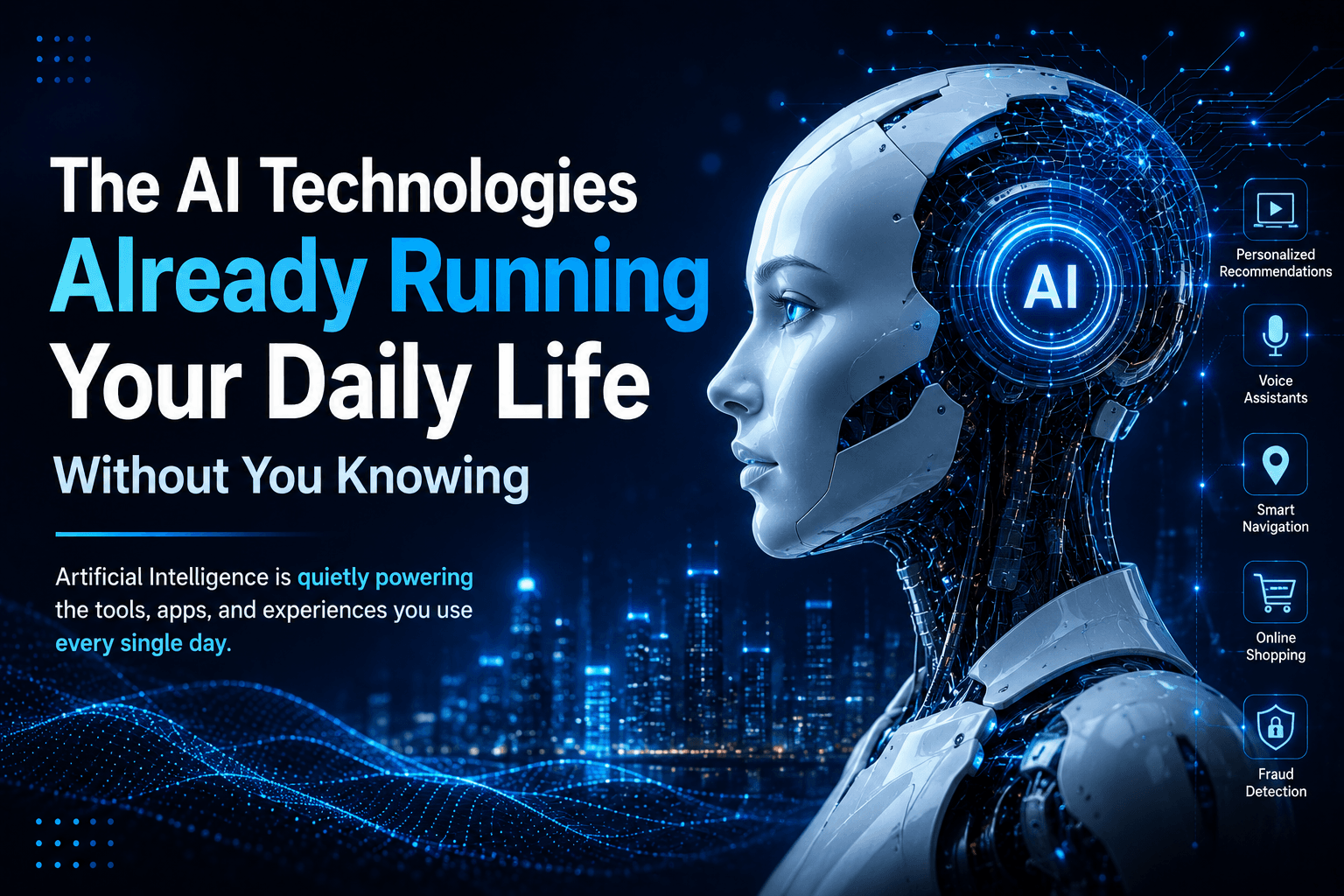
It is already running a significant part of your daily life. Every time you unlock your phone, search for something online, watch a video, or receive a product recommendation, AI tech are working quietly behind the scenes.
You do not need to be a technology expert to understand AI technology. You just need to know where to look, and this guide will show you exactly that.
AI Technologies Simply Explained — What Every Person Must Know
AI tech are software systems that can think, learn, and make decisions in ways that normally require human intelligence. They analyse enormous amounts of data, recognise patterns, and use those patterns to make predictions and decisions, faster and more accurately than any human could alone.
The key thing to understand is that AI techn get smarter over time. The more data they process, the better they become at their specific task. This is why the AI technology that recommends your next Netflix show seems to understand your taste better every week — because it genuinely does.
AI Technologies Already Running Your Daily Life
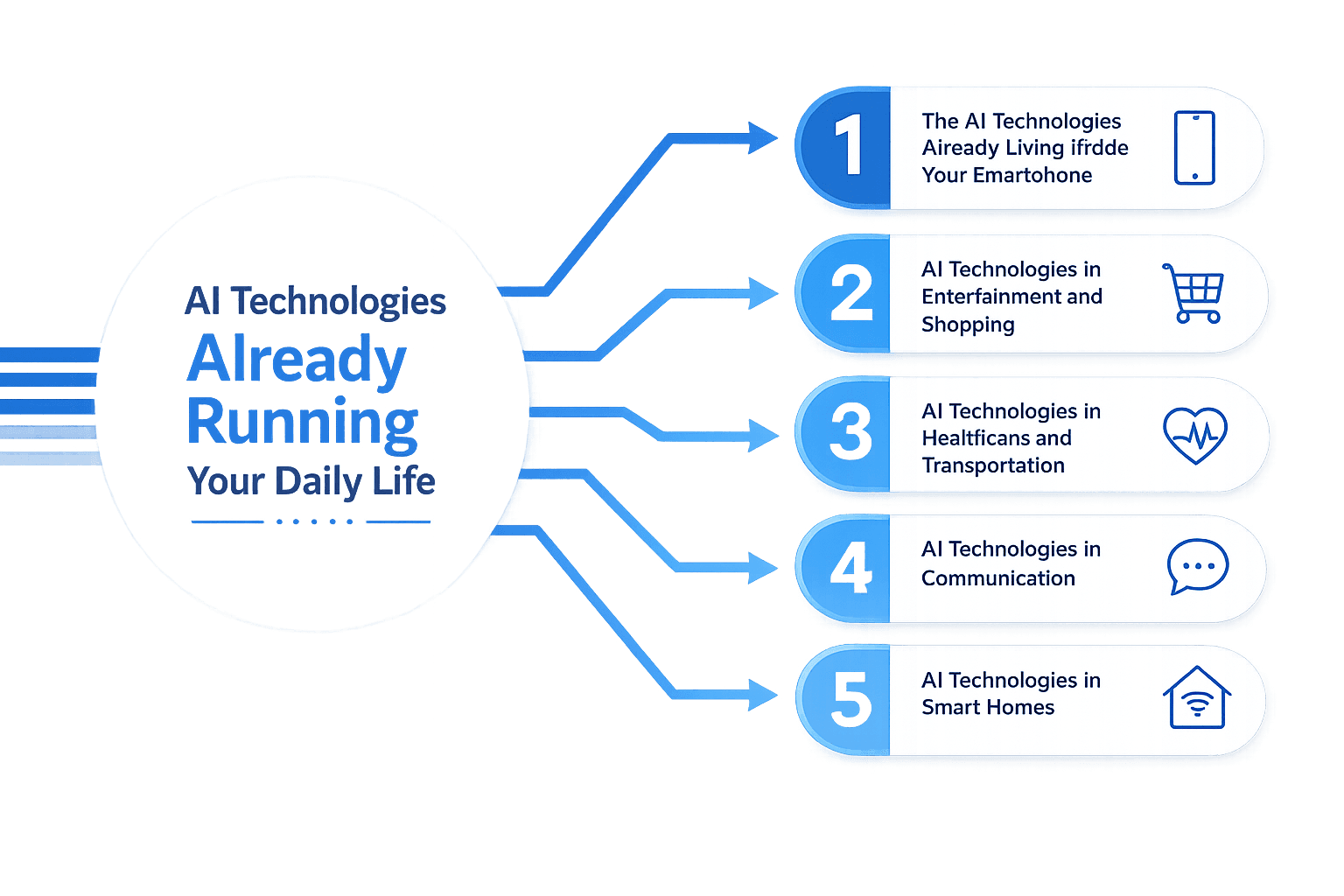
The AI Already Living Inside Your Smartphone
Your smartphone is one of the most AI-powered devices in existence — and most people have no idea how much artificial intelligence is working behind the scenes every moment.
Face Recognition
Every time you unlock your phone with your face, artificial intelligence analyses thousands of data points in milliseconds to verify your identity instantly and securely.
Voice Assistants
Siri and Google Assistant use artificial intelligence to understand what you say, interpret your intent, and respond appropriately while learning your accent and preferences over time.
Predictive Text
Every time your phone suggests the next word as you type, artificial intelligence analyses your writing patterns to predict what you are likely to type next.
Camera Enhancements
When your phone camera automatically adjusts lighting or applies portrait mode, artificial intelligence processes your images in real time to improve quality.
AI in Entertainment and Shopping
Streaming Recommendations
When Netflix or Spotify suggests content you end up enjoying, artificial intelligence analyses your viewing and listening habits to predict what you may like next.
Social Media Feeds
Every social media feed you scroll through is uniquely organized by artificial intelligence, which determines which posts and videos appear based on your interests and behaviour.
Product Recommendations
When an online store shows related products, artificial intelligence analyses the purchasing behaviour of millions of shoppers to predict what you might want next.
Fraud Detection
Every time you make an online payment, intelligent systems compare your transaction against thousands of data points in milliseconds to verify that the payment is genuinely from you.
AI in Healthcare and Transportation
Medical Image Analysis
Artificial intelligence can analyse X-rays and MRI scans with remarkable accuracy, helping identify early signs of diseases that may be difficult to detect manually.
Navigation Apps
Google Maps analyses real-time traffic data from millions of devices to predict congestion and calculate the fastest routes as conditions change.
Smart Driving Features
Artificial intelligence powers features such as adaptive cruise control, automatic emergency braking, and lane-keeping assistance in millions of vehicles today.
AI in Communication
Smart Email Filtering
Artificial intelligence automatically detects spam emails, prioritizes important messages, and organizes your inbox to save time.
Real-Time Language Translation
Translation tools can instantly translate text, voice, and conversations, helping people communicate across different languages.
AI in Smart Homes
Smart Home Automation
Artificial intelligence controls smart lights, thermostats, and security systems by learning your daily habits and preferences.
Smart Security Systems
AI-powered cameras can detect unusual activity, recognize faces, and send real-time alerts to improve home security.
Common Problems People Face With AI — And How to Solve Them
Artificial intelligence offers enormous benefits, but it also presents challenges that everyday users should understand.
AI Gives Wrong or Inaccurate Information
Artificial intelligence is not always correct. It can misunderstand context, provide outdated information, or generate inaccurate responses.
Solution: Never rely entirely on AI-generated information. Always verify important facts through trusted and reliable sources before making decisions.
AI Feels Confusing and Overwhelming
Many people feel intimidated because they do not fully understand how artificial intelligence works or where it is being used.
Solution: Start small. Learn how one AI-powered tool you already use works, such as a voice assistant, navigation app, or recommendation system. Understanding one tool at a time builds confidence.
Privacy Concerns
Artificial intelligence often relies on large amounts of personal data, including location information, browsing activity, purchase history, and usage patterns.
Solution: Review privacy settings regularly, limit unnecessary permissions, and only share information with applications you trust.
Lack of Human Interaction
When customer service or support is handled by chatbots, some people feel they are missing genuine human assistance.
Solution: Use AI for convenience, but don’t hesitate to request human support when dealing with complex, sensitive, or personal situations.
AI and Privacy — What You Should Know
One of the most important aspects of artificial intelligence is how it uses personal data.
What Data Is Collected?
Every search, video view, app interaction, and online purchase contributes information that helps systems improve their recommendations and predictions.
How Can You Protect Your Privacy?
- Review privacy settings regularly.
- Limit access to your location, camera, and microphone.
- Only grant permissions when necessary.
- Use trusted applications and services.
- Stay informed about how your data is being used.
Understanding how artificial intelligence interacts with your personal information helps you make smarter decisions and maintain greater control over your privacy.
The Real Truth Behind the Most Common AI Technologies Myths
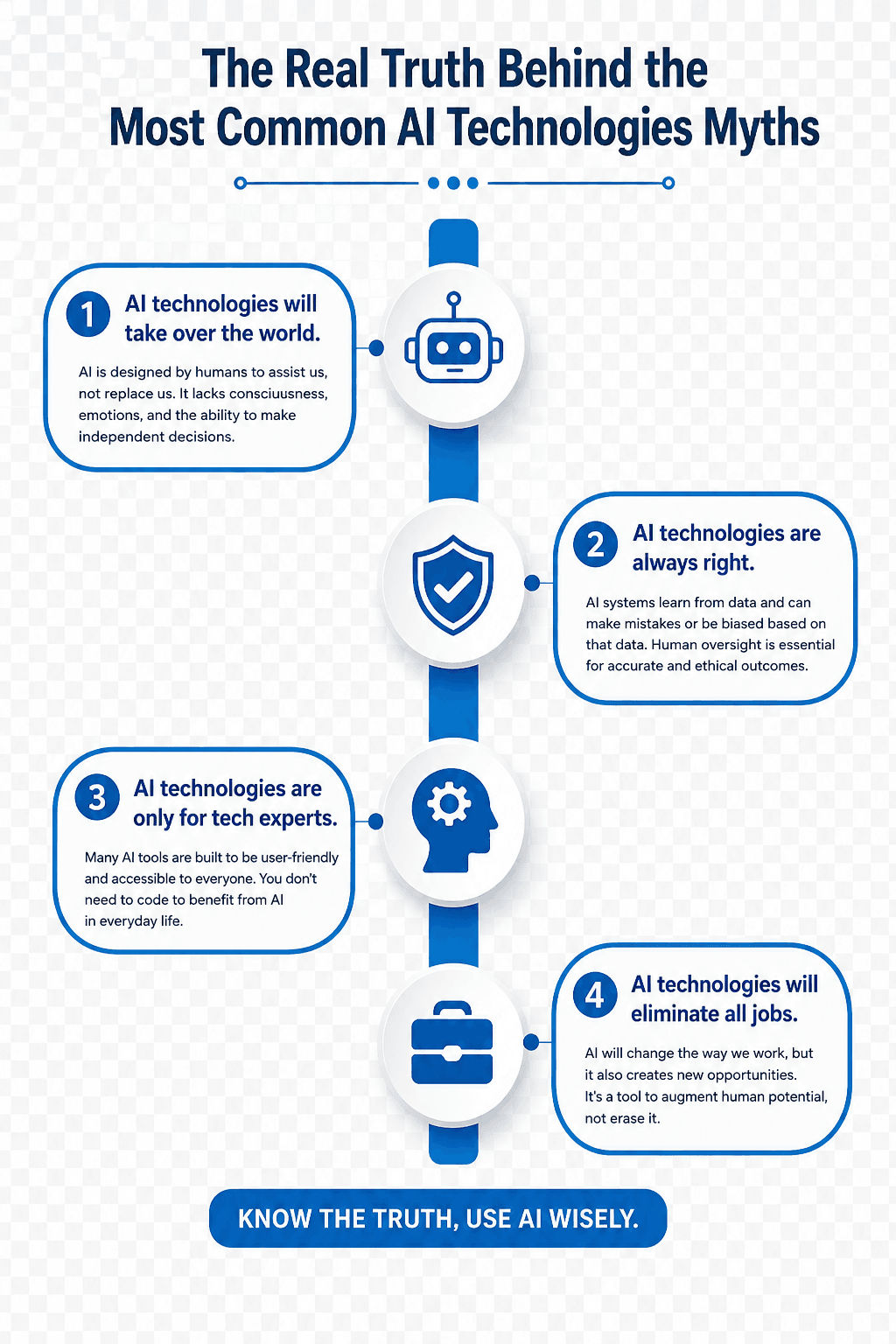
AI technologies will take over the world.
AI technologies are powerful tools — but they are tools. They do not have desires or ambitions. The idea of AI taking over is science fiction, not science fact.
AI technologies are always right.
AI technologies make mistakes. They can be biased and inaccurate — especially when trained on incomplete data. Always apply human judgment alongside AI recommendations.
AI technologies are only for tech experts.
Most AI technology are built into everyday apps that anyone can use without any technical knowledge. You are probably already using them every day without realising it.
AI technologies will eliminate all jobs.
AI technology are reshaping jobs — automating repetitive tasks and freeing humans to focus on creative and relationship-driven work. AI will change how we work rather than make human work obsolete.
AI Technologies That Are Coming Very Soon
Fully autonomous vehicles.
Self-driving cars that require no human input are already being tested on public roads and are expected to become commercially available very soon.
AI doctors.
AI technology are being developed that can diagnose diseases and recommend treatments with a level of accuracy that rivals experienced doctors — making quality medical care accessible everywhere.
Real-time language translation.
AI technologies are rapidly approaching the point where spoken conversation between two people speaking different languages can be translated instantly and accurately in real time.
Personalised AI assistants.
Future AI technologies will know your schedule, preferences, health, and goals well enough to proactively help you make better decisions in every area of your daily life.
FAQ
Q1. Why do AI technologies sometimes show irrelevant recommendations?
Update your preferences and interact with content that matches your interests. This helps AI technologies understand your behavior more accurately.
Q2. Are AI technologies collecting too much personal data?
Review privacy settings regularly and disable unnecessary permissions. Only allow access to data that is essential for the app’s functionality.
Q3. Why does my voice assistant misunderstand my commands?
Speak clearly and reduce background noise when giving commands. Most AI assistants improve accuracy as they learn your speech patterns.
Q4. Can AI technologies provide incorrect information?
Always verify important information through trusted sources. AI should be used as a helpful tool, not the sole source for critical decisions.
Q5. Why do social media platforms keep showing similar content?
Explore different topics and engage with diverse content. This helps AI algorithms provide a wider variety of recommendations.
Q6. Will AI technologies replace human jobs completely?
Focus on developing creative, analytical, and communication skills. AI is more likely to assist human work than completely replace it.
Q7. How can I identify AI technologies in the apps I use?
Look for features such as recommendations, chatbots, voice assistants, and automation. These are common indicators of AI-powered functionality.
Final Thought
AI technologies are not coming in the future. They are already here—already in your pocket, your home, your car, and your entertainment.
Understanding AI technologies, what they are, how they work, the challenges they create, and what lies ahead gives you the knowledge to use them confidently and effectively. The more you understand AI technologies, the better equipped you are to benefit from everything they offer today and in the years to come.
For businesses looking to embrace digital transformation and AI-driven solutions, partnering with the best website design company in Coimbatore can help create smarter, more engaging online experiences that drive growth and customer satisfaction.
The future of AI is not something to wait for, it is something to understand, adapt to, and leverage starting today.