Introduction
Artificial intelligence for business is no longer optional. Businesses of all sizes are using AI to improve efficiency, respond to customers faster, reduce costs, and make better decisions.
This is not limited to large enterprises. Small and medium-sized businesses are adopting AI to gain a competitive advantage and streamline everyday operations.
In this guide, you’ll learn how your competitors are using artificial intelligence for business and the practical steps you can take to start benefiting from it.
What Artificial Intelligence for Business Really Means
Artificial intelligence for business is simply the use of smart software to automate tasks that would otherwise require manual effort. It can help businesses respond to customers, analyze data, create content, manage schedules, and streamline daily operations.
You do not need technical expertise to use AI. The key is understanding how it can solve business challenges and improve efficiency.
Why Your Competitors Started Before You
The businesses ahead of you did not wait for artificial intelligence to be perfect. They started early, learned fast, and built advantages that are now very difficult to close.
Here is what they understood early:
They started early and kept improving over time
Artificial intelligence allows businesses to respond to customers and make decisions faster than any human team can manage alone. Being faster than your competitor is often the difference between winning and losing a customer.
Speed gave them a clear competitive advantage
Without automation, growth requires hiring more people and spending more money. Artificial intelligence for business removes that ceiling — you handle more customers and more complexity without costs growing at the same rate.
They quickly adapted to changing customer expectations
Customers today expect instant responses and personalised experiences at every touchpoint. Artificial intelligence makes this possible consistently at a scale no human team can match alone.
Your competitors understood these things and acted. Now you know too. The next step is taking action before the gap gets any wider.
Where Your Competitors Are Using Artificial Intelligence for Business
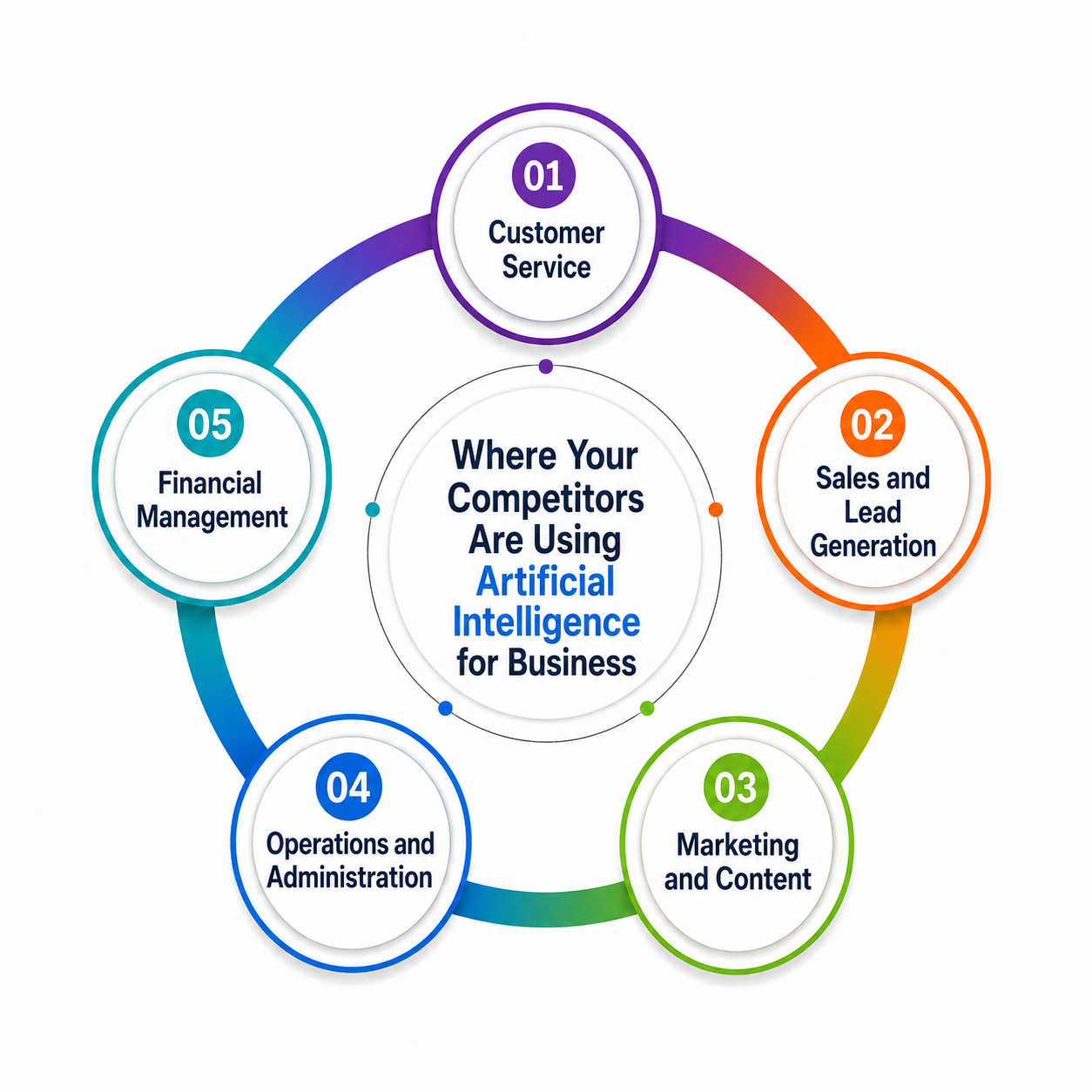
Customer service.
AI tools handle customer enquiries and answer common questions around the clock without human involvement. Customers get instant help at any hour, while businesses significantly cut support costs.
Sales and lead generation.
Artificial intelligence identifies the most promising leads, personalises outreach, and follows up automatically. Sales teams spend their time on the best opportunities — not chasing cold leads that go nowhere.
Marketing and content.
Businesses use artificial intelligence to write social media posts, email campaigns, and blog content faster than any human writer could. They also analyse which messages work best with which audiences and adjust their marketing accordingly.
Operations and administration.
Repetitive internal tasks — scheduling, invoicing, data entry, report generation — are being automated with artificial intelligence for business. Human teams focus entirely on work that requires genuine judgment and creativity.
Financial management.
Artificial intelligence monitors cash flow, forecasts revenue, and identifies cost-saving opportunities — giving business owners clearer financial visibility with far less manual effort.
The Real Cost of Doing Nothing
Many business owners delay adopting artificial intelligence because it feels unfamiliar. But waiting has a real and growing cost.
You are slower than your competitors.
Every hour your team spends on tasks AI could complete in seconds is time your competitors use to serve customers better.
You are paying more than you need to.
Artificial intelligence reduces manual work across many business functions — lowering costs without reducing output or quality.
You are losing customers quietly.
Customers who do not receive an instant response will go to a competitor who provides it. They often will not tell you why they left.
The gap is widening every month.
Every month of delay makes that gap harder and harder to close.
How to Start Using Artificial Intelligence for Business Today
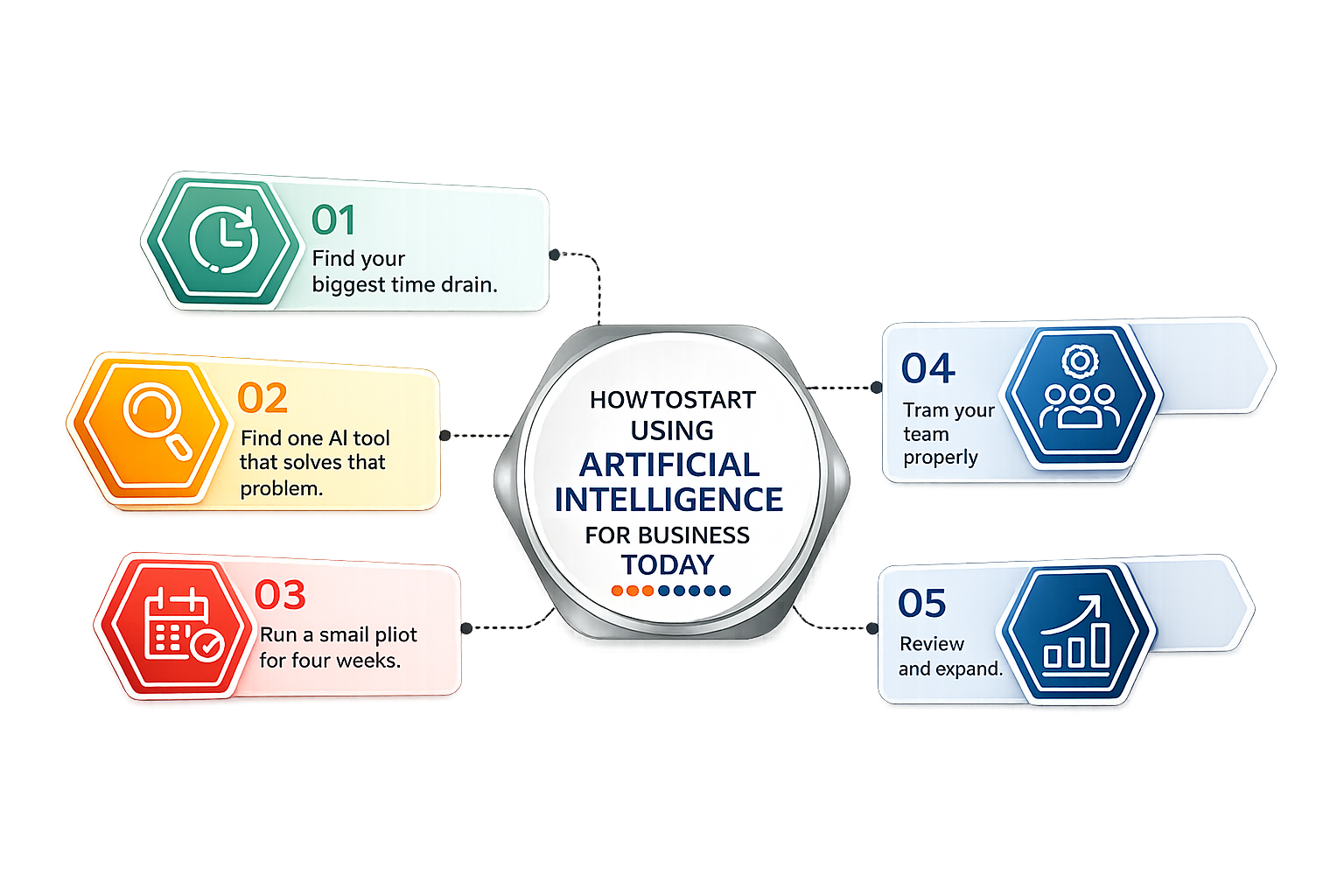
Find your biggest time drain.
What task consumes the most time without requiring complex human judgment? Common examples include responding to customer enquiries, scheduling appointments, generating reports, and processing invoices.
Find one AI tool that solves that problem.
AI tools are available for nearly every business function. Choose one tool that directly addresses your most pressing challenge and start there. Focus on implementing a single solution effectively before considering additional tools.
Run a small pilot for four weeks.
Use the AI tool alongside your existing process for four weeks. Measure the time saved, cost reduced, and quality of output compared to your current approach.
Train your team properly.
Artificial intelligence for business works best when your team understands how to use it. Set aside time to train everyone who will interact with the tool.
Review and expand.
After four weeks, evaluate the results. If the tool is increasing efficiency and delivering better outcomes, expand its use across relevant processes. Then identify the next business challenge and apply the same approach to drive continuous improvement.
Common Mistakes to Avoid
Trying to automate everything at once.
Start with one task, do it well, then expand gradually.
Choosing tools without a clear purpose.
Always start with a specific business problem — then find the tool that solves it directly.
Giving up too early.
Most businesses begin to see measurable results from AI adoption within two to three months of consistent implementation and optimization. Success does not happen overnight, so it is important to give your AI initiatives time to deliver meaningful improvements.
Not involving your team.
If your team does not understand why you are introducing artificial intelligence or how to use it, adoption will fail regardless of how good the tool is.
FAQ
1. What is the first step to introducing AI into my business?
Start by identifying repetitive tasks, operational challenges, or customer service bottlenecks. Then choose AI solutions that address those specific business needs and deliver measurable results.
2. We are spending too much time on repetitive tasks. How can AI help?
AI can automate routine processes such as data entry, customer support, appointment scheduling, and email responses, allowing your team to focus on higher-value work.
3. Our marketing campaigns are not generating enough leads. Can AI improve results?
Yes. AI can analyze customer behavior, optimize advertising campaigns, create targeted content, and identify high-quality leads to improve marketing performance.
4. We have customer data, but struggle to use it effectively. What should we do?
AI-powered analytics tools can turn customer data into actionable insights, helping you make smarter business decisions and identify growth opportunities.
5. Our customer support team is overwhelmed. Can AI reduce the workload?
AI chatbots and virtual assistants can handle common customer inquiries 24/7, reducing response times and improving customer satisfaction.
6. We are worried that AI implementation will be expensive. Is it worth the investment?
Many AI solutions are affordable and scalable. Businesses often see returns through increased efficiency, reduced operational costs, and improved customer engagement.
7. How can small businesses compete with larger companies using AI?
AI helps small businesses automate operations, improve customer service, and make data-driven decisions, allowing them to compete more effectively with larger organizations.
Final Thought
AI development company in CoimbAI development company in coimbatore atore for business is already here — and your competitors are already using it every single day.
The businesses seeing the greatest success today are not necessarily the largest or the most heavily resourced. They are the ones who took action early. They identified a specific business challenge, selected the right AI solution, launched a small pilot project, measured the results, and gradually expanded their adoption based on proven outcomes. That is all it takes. One decision. One tool. One pilot.
Start today. Start small. And build the advantage your business deserves.