Introduction
Marketing has always been about reaching the right people with the right message at the right time; for decades, that required large teams, significant budgets, and enormous amounts of manual effort.
Artificial intelligence is changing all of that – and changing it fast.
Understanding how AI for marketing helps businesses is one of the most important things any business owner can learn right now. AI is not replacing marketing – it is making marketing smarter, faster, more personalised, and more effective than ever before.
AI for Marketing: What It Really Means
AI for marketing is not about robots or complex technology. It simply means using intelligent tools to automate tasks, analyse data, create content, personalise customer experiences, and improve marketing performance.
It does not replace strategy or human creativity. Instead, AI helps businesses make their existing marketing efforts faster, smarter, and more efficient — saving valuable time and resources.
How AI Is Already Changing Marketing Right Now
AI is not a future trend. It is already transforming how businesses of every size reach and convert their customers every single day.
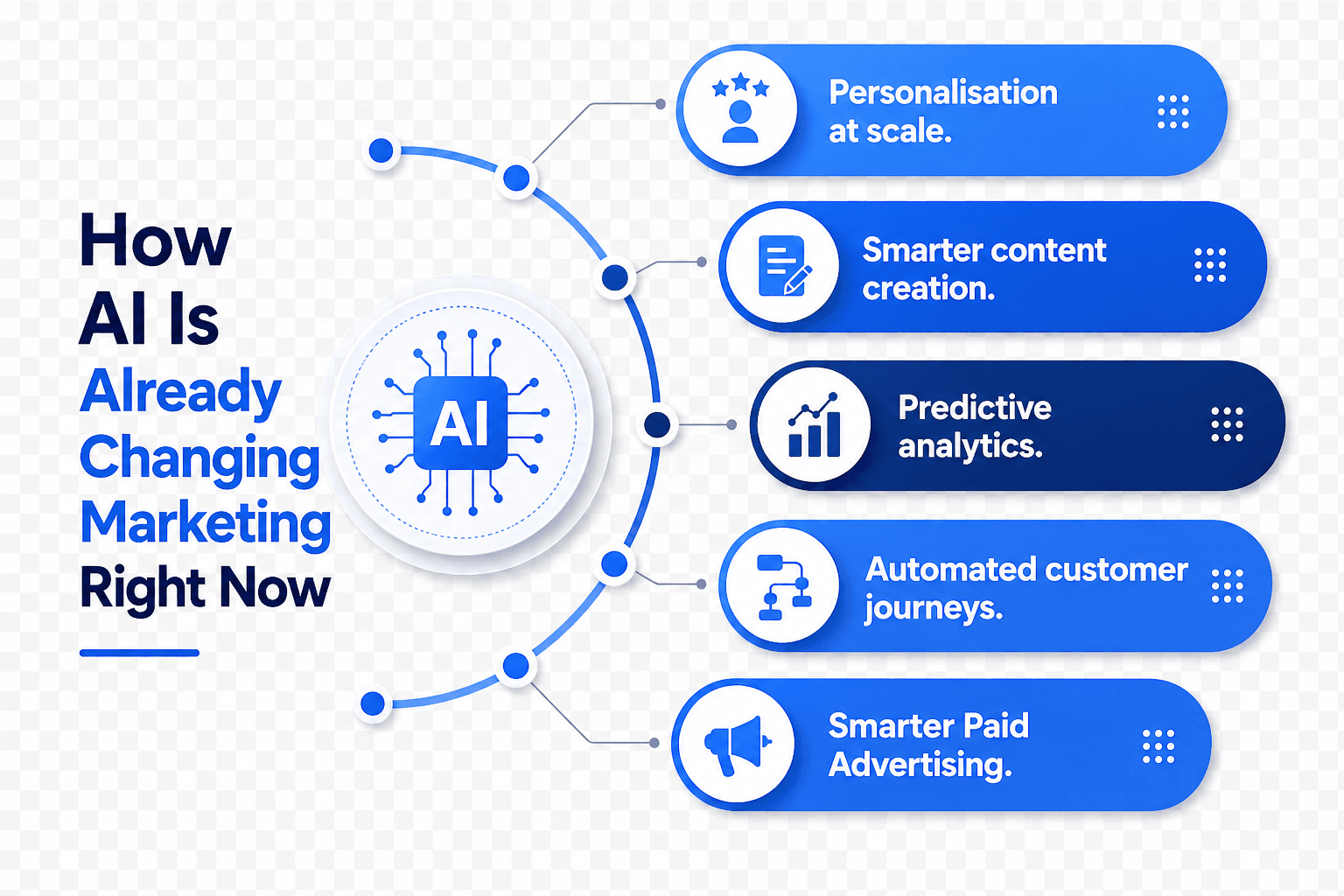
Personalisation at scale.
AI delivers a different, personalised message to every individual based on their behaviour, preferences, and purchase history — automatically, in real time, across thousands of customers simultaneously.
Smarter content creation.
AI writing tools help businesses create blog posts, social media captions, email campaigns, and ad copy significantly faster — removing the blank page problem and accelerating the entire content process.
Predictive analytics.
AI analyses historical data to predict which customers are most likely to buy, which are at risk of leaving, and which marketing messages are most likely to convert — allowing businesses to focus budget on the highest-probability opportunities.
Automated customer journeys.
Welcome emails, abandoned cart reminders, re-engagement campaigns, and post-purchase follow-ups all happen automatically — triggered by customer behaviour without any manual intervention from your team.
Smarter Paid Advertising.
AI continuously analyses campaign performance and automatically optimises targeting, bidding, and ad creatives to improve results and maximise return on ad spend.
How AI for Marketing Helps Businesses Get More Done With Less Time and Money
This is where understanding how AI for marketing helps businesses becomes most practical and most valuable.
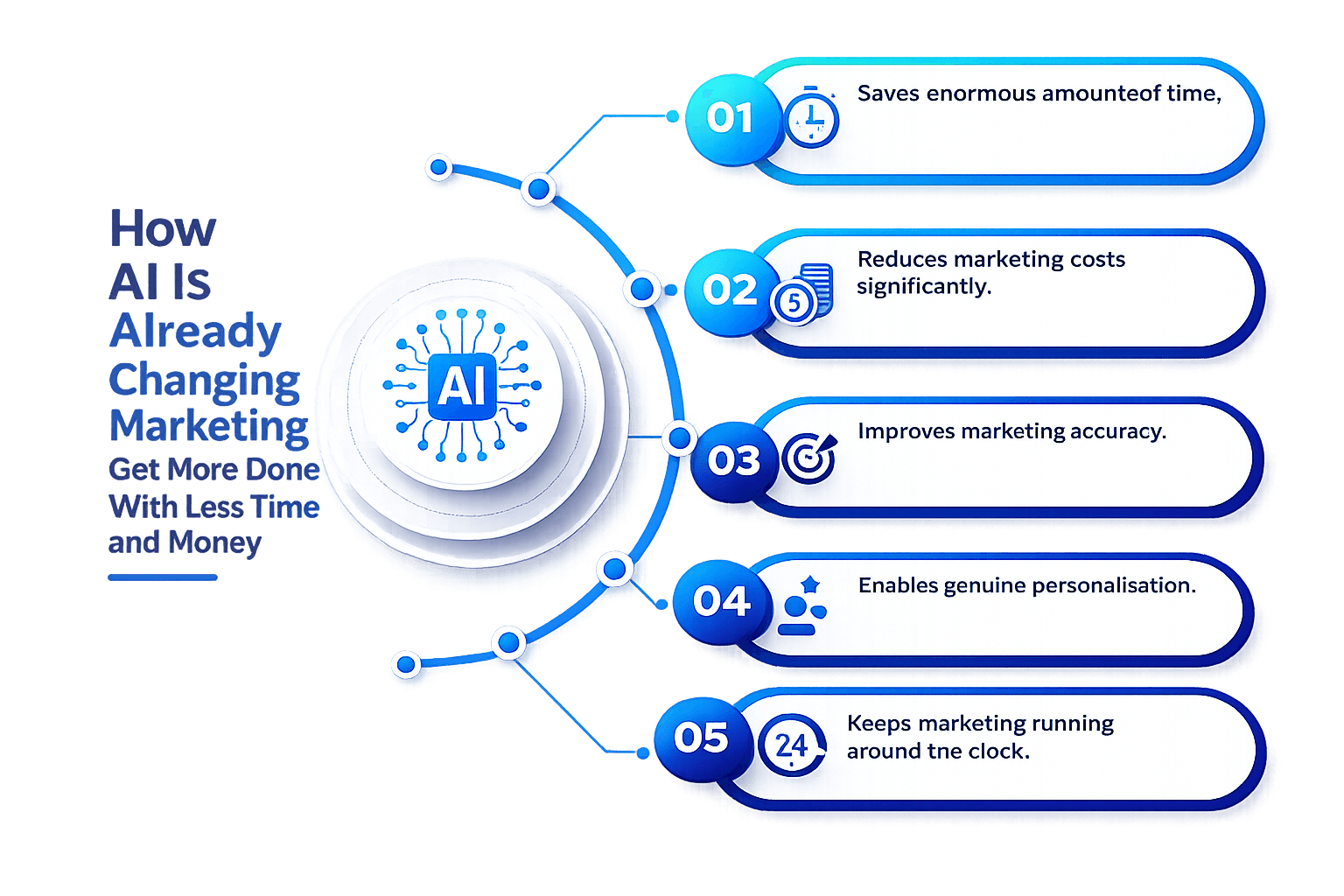
Saves enormous amounts of time.
Tasks that previously took hours – writing content, analysing data, segmenting email lists, scheduling posts – now take minutes. This time saving compounds across every marketing activity your business runs every single day.
Reduces marketing costs significantly.
AI automates repetitive time-consuming tasks that previously required human effort – allowing smaller teams to achieve results that previously required much larger ones at much higher cost.
Improves marketing accuracy.
AI identifies patterns, trends, and opportunities in data that human analysis would miss entirely – leading to better decisions and consistently better marketing results across every channel.
Enables genuine personalisation.
Personalised marketing consistently delivers higher open rates, higher click rates, and higher conversion rates than generic marketing. AI makes true one-to-one personalisation achievable at scale for businesses of any size.
Keeps marketing running around the clock.
AI-powered automation works twenty-four hours a day, seven days a week — nurturing leads, sending emails, and optimising ads even while your team is offline.
The AI Marketing Tools Every Business Should Know About
Understanding which tools are delivering real value helps businesses make smarter decisions about where to start.
AI writing tools
AI writing tools like Jasper and Copy.ai create blog posts, social media captions, email campaigns, and ad copy in a fraction of the time traditional writing requires — giving marketing teams a powerful head start on every piece of content.
AI email marketing tools
AI email marketing tools like Klaviyo and Mailchimp personalise email content, optimise send times, predict which subscribers are most likely to convert, and automate complex multi-step email sequences without manual setup.
AI social media tools
AI social media tools like Buffer and Hootsuite suggest optimal posting times, recommend content ideas, analyse engagement patterns, and automate scheduling across multiple platforms simultaneously.
AI advertising platforms
AI advertising platforms like Meta Ads Manager and Google Ads use machine learning to automatically optimise campaign targeting, bidding, and creative — improving return on ad spend continuously without manual intervention.
AI chatbots
AI chatbots like Tidio and Intercom handle customer enquiries, qualify leads, and provide instant responses around the clock — improving customer experience while reducing pressure on human support teams significantly.
What Changes When a Business Starts Using AI for Marketing
Most business owners are surprised by how quickly things change when they start applying AI to their marketing consistently.
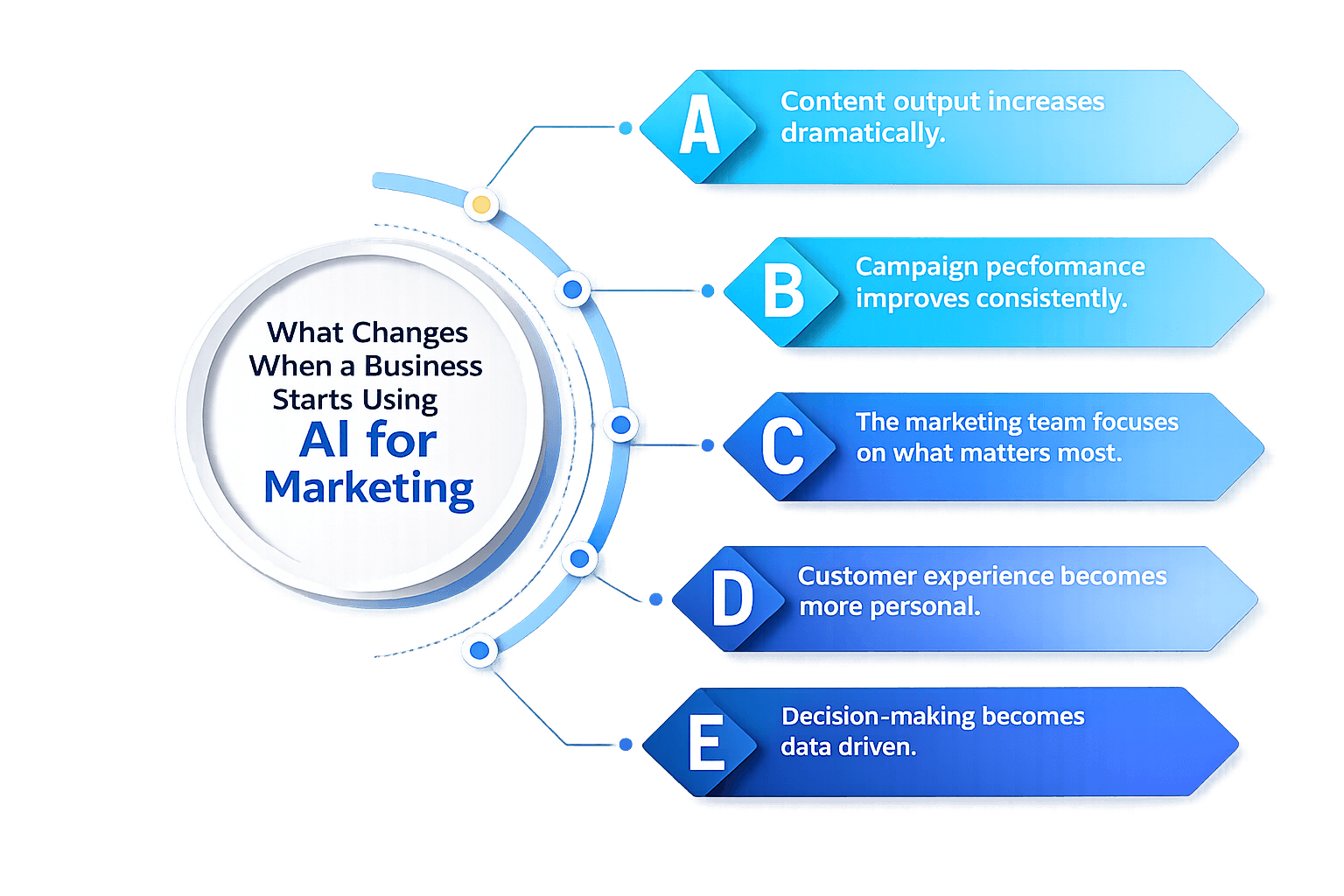
Content output increases dramatically.
Businesses that previously published one blog post per month start publishing four or more – because AI removes the time barrier that was slowing them down.
Campaign performance improves consistently.
AI-optimised campaigns deliver better results over time because the algorithm continuously learns from performance data and adjusts automatically.
The marketing team focuses on what matters most.
When AI handles repetitive and analytical work, human marketers focus entirely on strategy, creativity, and relationship-building — the areas where human skill genuinely cannot be replaced.
Customer experience becomes more personal.
Customers receive communications that feel genuinely relevant to them — because AI is delivering the right message at the right moment based on their specific behaviour and preferences.
Decision-making becomes data-driven.
AI surfaces insights from marketing data that previously required expensive analytics teams – giving every business owner the information they need to make confident, strategic marketing decisions.
The Difference Between AI-Powered Marketing and Traditional Marketing
Understanding how AI for marketing helps businesses requires understanding what is fundamentally different about the AI-powered approach compared to how marketing was done before.
Traditional marketing
Traditional marketing sends the same message to a broad audience, analyses results manually after campaigns end, requires significant human effort for every task, and optimises slowly based on periodic reviews.
AI-powered marketing
AI-powered marketing delivers personalised messages to individuals, analyses results in real time, automates repetitive tasks, and continuously optimises based on live performance data.
The shift from traditional to AI-powered marketing is not just about doing the same things faster. It is about doing previously impossible things — personalisation at scale, real-time optimisation, and predictive intelligence that anticipates customer needs before they are even expressed.
Common Mistakes Businesses Make With AI for Marketing
Using AI without a strategy.
AI amplifies what is already there – a weak marketing strategy becomes a weak AI-powered strategy. Always have a clear goal before introducing any AI tool.
Over-automating customer interactions.
Some customer interactions require genuine human empathy and relationship-building. Over-automating makes brands feel cold and impersonal — damaging the trust that marketing is designed to build.
Ignoring data quality.
AI is only as good as the data it learns from. Poor quality or incomplete customer data produces poor quality insights regardless of how advanced the tool is.
Expecting immediate results.
AI tools improve over time as they collect more data. Businesses that abandon AI tools after a few weeks never give them enough time to deliver their full value.
Simple Tips for Using AI for Marketing Effectively
Start with your biggest pain point.
Identify the marketing task that consumes the most time or produces the least consistent results — and find one AI tool specifically designed to solve that problem first.
Use AI to enhance human creativity — not replace it.
The most effective AI marketing combines AI speed and scale with human creativity and strategic thinking. Use AI for the repetitive and analytical — keep humans focused on the creative and relational.
Keep the customer experience human.
Even when AI powers your marketing behind the scenes, every customer-facing touchpoint should feel warm, personal, and genuinely helpful. AI should make personalisation more achievable — not make your marketing feel robotic.
Test before you scale.
Start with one AI tool and one use case. Measure results carefully before scaling across more of your marketing or adding new AI tools to the mix.
Review AI Outputs Carefully
AI-generated content is a starting point — not a finished product. Always review, refine, and add human judgment before publishing any AI-generated content on LinkedIn.
FAQ
Q1. Do small businesses need AI for marketing?
Yes — AI tools are affordable and accessible for businesses of every size and deliver the biggest relative benefit to smaller teams with limited time and resources.
Q2. Will AI replace marketing teams?
No — AI handles repetitive and analytical tasks so marketing teams can focus entirely on creativity, strategy, and relationship-building that requires genuine human skill.
Q3. How much does AI for marketing cost?
Many AI marketing tools offer free plans or affordable subscriptions starting from a few hundred rupees per month — making them accessible for businesses at every stage.
Q4. Which AI marketing tool should I start with?
Start with the tool that solves your biggest marketing challenge. Content creation—try an AI writing tool. Email marketing—try an AI email platform. Customer service—try an AI chatbot.
Q5. How long before AI marketing tools show results?
Most businesses see time savings within the first few weeks. Improved marketing performance typically becomes clear after two to three months of consistent use.
Q6. Is AI-generated content good enough to publish?
AI content is a strong starting point but always requires human review and refinement. The best results combine AI speed with human judgment and creativity.
Q7. Can AI marketing tools work with existing software?
Yes—most modern AI marketing tools integrate with popular platforms including email tools, CRM systems, social media platforms, and advertising networks.
Conclusion
AI is transforming marketing by helping businesses work smarter, move faster, and create more personalised customer experiences.
Start with one tool, solve one problem, and measure the results. The businesses that adopt AI Marketing today are already gaining an advantage in efficiency, targeting, and growth. AI for marketing is no longer a future opportunity – it is already shaping how businesses reach, engage, and convert customers.