Introduction
Every business wants to rank on Google’s first page because that’s where most clicks, traffic, and potential customers come from. However, achieving top rankings requires more than just publishing content or adding keywords. A successful SEO strategy combines keyword research, high-quality content, on-page optimization, technical SEO, and continuous improvement. In this guide, you’ll learn the complete SEO strategy to help your website improve its visibility and rank higher on Google.
This guide covers exactly that – step by step.
Why Google’s First Page Matters for Business Growth
Before exploring how to rank on Google’s first page, it is important to understand why achieving top search visibility can make a major difference for your business.
Most users focus on first-page results.
When people search for products or services on Google, they usually choose from the websites that appear on the first page. If your business website ranks lower in search results, potential customers may never discover your brand, even if you offer better products or services.
Higher rankings improve trust and credibility.
A website that appears at the top of Google results often creates a stronger first impression. Customers tend to trust businesses that rank higher because they associate top positions with reliability, authority, and industry expertise.
Organic traffic brings valuable customers.
Visitors who find your website through a Google search are already looking for solutions related to your business. This makes organic traffic more valuable because these users have a higher chance of becoming customers compared to general visitors from other sources.
SEO delivers long-term business benefits
Unlike paid advertisements that stop bringing traffic once the budget ends, a well-optimized website can continue attracting visitors through search engines over time. With consistent SEO efforts, first-page rankings can become a long-term source of leads, visibility, and business growth.
How Google Decides Which Websites Rank on the First Page
Understanding how Google makes its ranking decisions is essential — because everything in your SEO content strategy should be built around them.
Google’s primary goal is simple — to show searchers the most relevant, useful, and trustworthy results for every query. Here are the most important signals every business owner must understand.
Relevance.
Google analyses every page to understand what topics it covers and how closely they match what a searcher is looking for. Pages that clearly address the searcher’s query are considered more relevant — and more relevant pages rank higher.
Authority.
Google measures how trustworthy your website is relative to competitors. Authority is built primarily through quality backlinks from reputable websites — each one acting as a vote of confidence in your content.
User experience.
Google monitors how users interact with your website after clicking from search results. Visitors who stay and engage tell Google your page deserves its ranking. Visitors who leave immediately push your page down.
Technical quality.
Google evaluates how fast your website loads, whether it works on mobile, and whether it is free from errors that prevent Google from crawling your content properly.
Content freshness.
Google favours recently updated content over older, unmaintained pages. Keeping your most important pages current signals that your content is a reliable and up-to-date resource.
What Google Looks for Before Ranking a Website on the First Page
Knowing how to rank on Google’s first page requires understanding the specific criteria Google evaluates before deciding whether a website deserves first-page visibility.
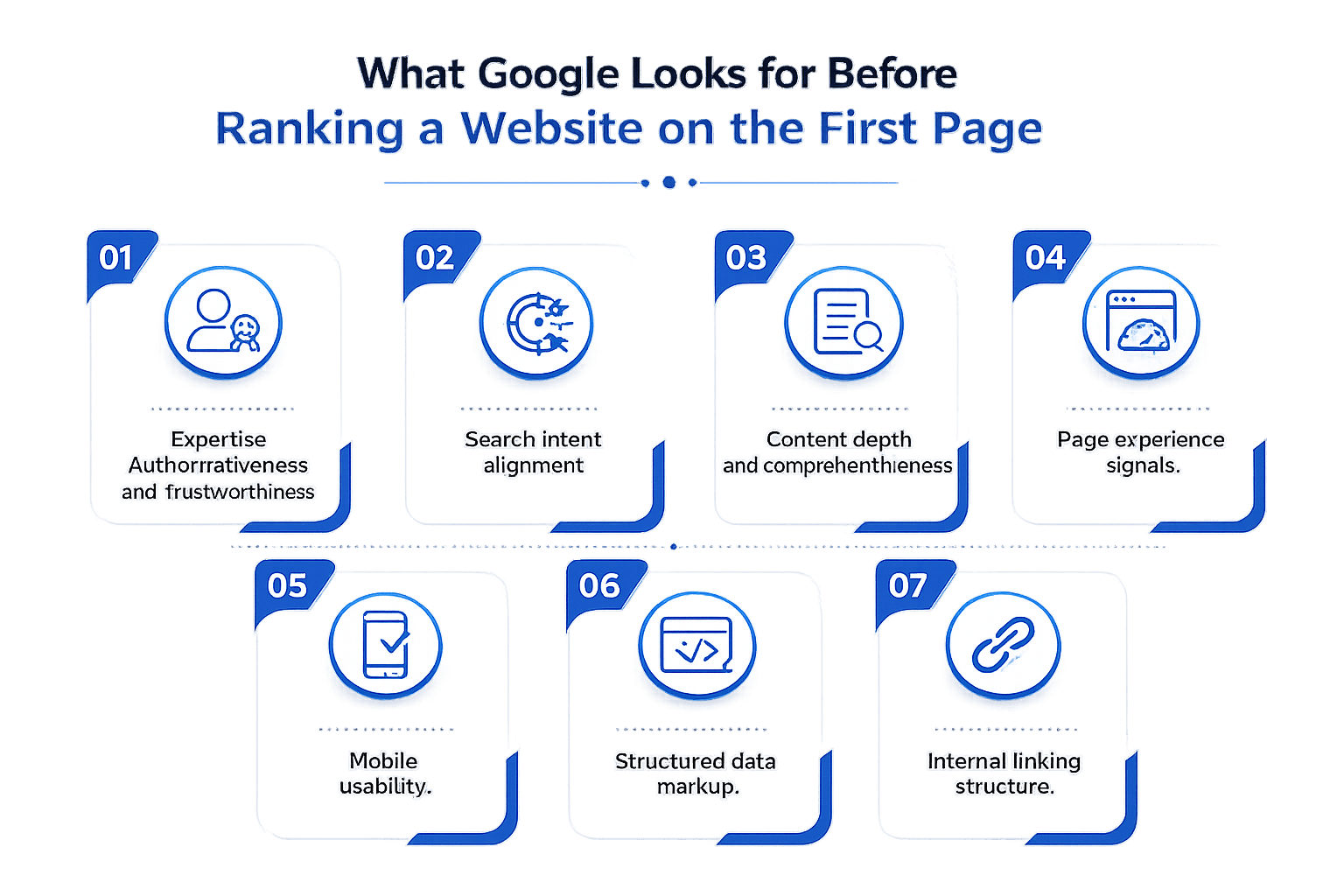
Expertise, Authoritativeness, and Trustworthiness.
Google uses E-E-A-T to evaluate content quality — whether the content demonstrates real expertise, whether the website is recognised as an authority, and whether the content can be trusted to be accurate and honest.
Search intent alignment.
Google determines whether the content genuinely matches what the searcher wants to accomplish. Content written to sell rather than inform will not rank well for informational searches — because it does not match what the searcher actually needs.
Content depth and comprehensiveness.
Google consistently favours content that covers a topic thoroughly. A comprehensive guide that answers every question a searcher might have consistently outranks a shorter piece that only addresses part of the topic.
Page experience signals.
Google measures Core Web Vitals — how fast your page loads, how quickly it responds to interactions, and how stable the layout is as it loads. These are direct ranking factors every website must address.
Mobile usability.
Google primarily evaluates the mobile version of your website when determining rankings. A website that works perfectly on desktop but poorly on mobile will struggle to rank regardless of content quality.
Structured data markup.
Schema markup helps Google understand the specific content and context of your pages more clearly — improving the chances of receiving rich result features that increase visibility and click-through rates.
Internal linking structure.
How your pages link to each other tells Google which pages are most important and how your content relates. A well-planned internal linking structure distributes ranking authority across your most important pages efficiently.
What a Complete SEO Content Strategy Actually Includes
Most business owners think SEO is simply about adding keywords to their website. A complete SEO content strategy is far more comprehensive — and understanding each component is essential to knowing how to rank on Google’s first page consistently.
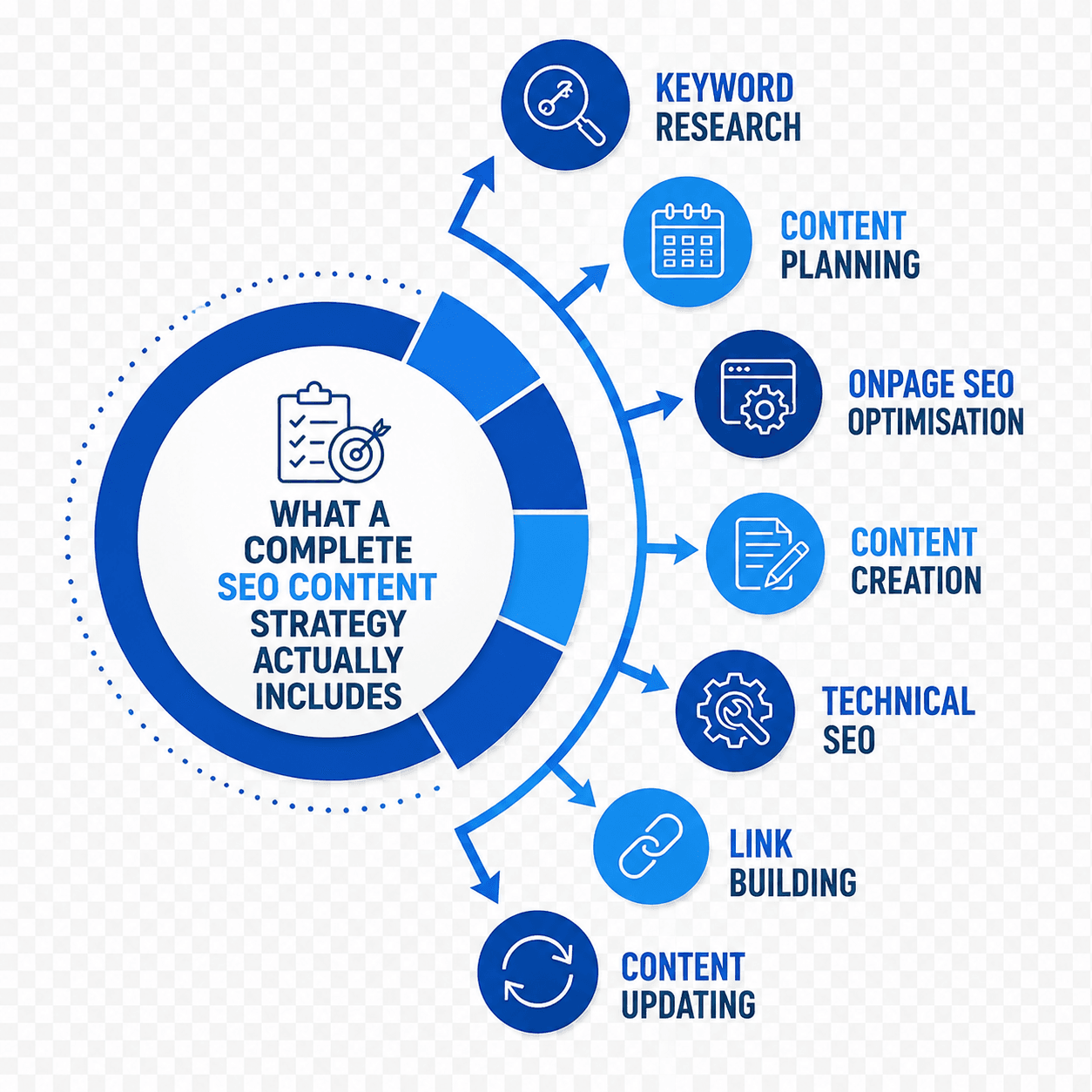
Keyword research.
Every effective SEO content strategy begins with understanding exactly what words and phrases your target customers type into Google. These keywords become the foundation of every piece of content you create.
Content planning.
Based on keyword research, you create a structured content plan — identifying which pages and blog posts to create, which keywords each piece will target, and how each piece fits into your overall website structure.
On-page SEO optimisation.
Every page must be optimised for its target keyword — with the keyword appearing naturally in the title, meta description, headings, body content, and image alt text.
Content creation.
High-quality, genuinely useful content is the single most powerful factor in how to rank on Google’s first page. Google rewards content that thoroughly answers the questions your target audience is asking.
Technical SEO.
Your website must be technically sound — fast loading, mobile-friendly, properly structured, and free of errors that prevent Google from crawling and indexing your content correctly.
Link building.
Earning quality backlinks from reputable websites signals to Google that your content is trustworthy and authoritative — directly improving your first-page ranking potential.
Content updating.
Regularly updating and improving existing content keeps it relevant, accurate, and competitive — helping you maintain and improve your rankings over time.
Step-by-Step SEO Content Strategy to Rank on Google’s First Page
Here is the exact step-by-step process for building an SEO content strategy that gets your business onto Google’s first page.
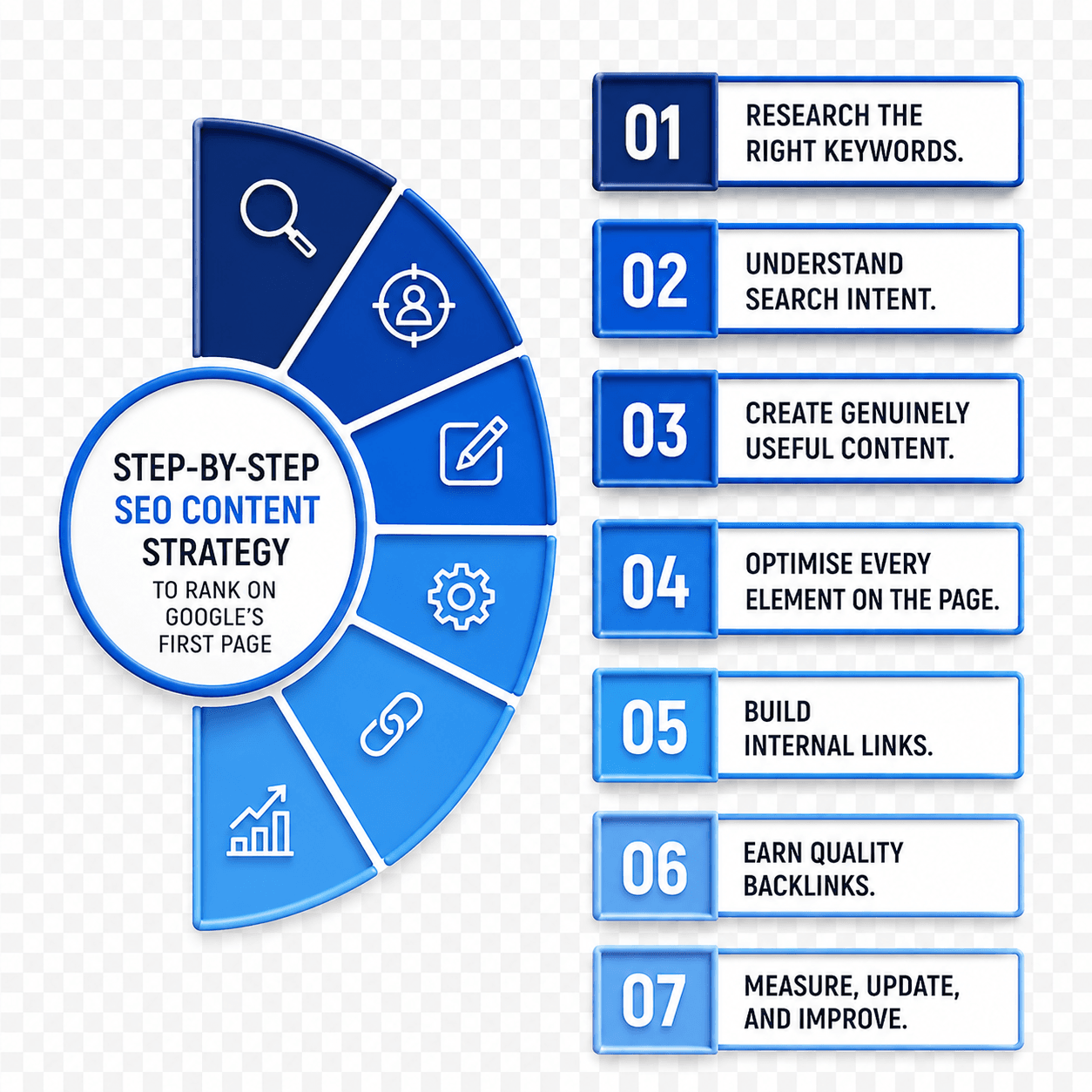
Research the right keywords.
Focus on keywords with genuine search volume, realistic competition levels, and clear commercial intent. Long-tail keywords are often easier to rank for and attract more qualified visitors.
Understand search intent.
For every keyword, understand exactly what the searcher wants to find. Create content that perfectly matches the intent behind each keyword — because Google’s primary goal is to show searchers exactly what they are looking for.
Create genuinely useful content.
Write content that thoroughly covers your topic and genuinely helps your target audience. Go deeper than your competitors. Answer every question a searcher might have.
Optimise every element on the page.
Include your target keyword in your page title, meta description, main heading, subheadings, opening paragraph, and naturally throughout your content.
Build internal links.
Link from new content to existing relevant pages and from existing pages back to new content. Internal linking helps Google understand your website structure and distribute ranking authority effectively.
Earn quality backlinks.
Reach out to relevant websites and industry publications to earn quality backlinks. Create content so genuinely useful that other websites naturally want to link to it as a resource.
Measure, update, and improve.
Monitor your rankings, traffic, and engagement metrics regularly. Update existing content when it becomes outdated or when competitors publish stronger content on the same topic.
What Happens After Content Is Given to an SEO Team
Understanding what an SEO team does after receiving your content helps you appreciate the full scope of work involved in how to rank on Google’s first page.
Keyword mapping.
The SEO team maps each piece of content to its primary and secondary target keywords — ensuring every page is optimised for the right terms without competing against other pages on the same website.
On-page optimisation.
Every element of the content is optimised — title tags, meta descriptions, heading structure, keyword placement, image alt text, and internal linking — to maximise the page’s relevance and visibility.
Technical checks.
The SEO team verifies that the content loads quickly, displays correctly on mobile devices, and contains no technical errors that could prevent Google from crawling or indexing the page effectively.
Content quality review.
The content is reviewed for depth, accuracy, readability, and genuine usefulness. Thin or shallow content is expanded. Missing information is added. The goal is always to create the most comprehensive resource available for the target keyword.
Submission to Google.
Once optimised, the page is submitted to Google Search Console for indexing — prompting Google to crawl and evaluate the page as quickly as possible.
Performance monitoring.
After the page is indexed the SEO team monitors its ranking position, organic traffic, click-through rate, and user engagement metrics — using that data to identify further optimisation opportunities.
Common SEO Content Problems and How to Fix Them
Content is ranking, but not on the first page.
Your content appears in search results but consistently ranks between positions eleven and thirty, missing the first page where the vast majority of clicks occur.
Solution. Audit the content ranking above yours for the same keyword. Identify what they cover that your content does not. Add missing information, improve your content structure, and build more quality backlinks to push your page into the top ten positions.
Content is published, but not appearing in Google.
Your content has been published for weeks, but does not appear in Google search results for any relevant keywords.
Solution. Submit your page directly through Google Search Console to prompt indexing. Check for technical errors preventing Google from crawling your page — including noindex tags, blocked resources, or canonical tag issues.
Content was ranking well, but the rankings have dropped.
Your content was performing well on Google’s first page, but has recently dropped significantly.
Solution. Check whether a Google algorithm update may have affected your rankings. Review whether competitors have published stronger content on the same topic. Update your content with fresh information and improved depth to reclaim your previous ranking position.
FAQ
1. Why isn’t my website ranking on Google’s first page?
Your website may lack quality content, proper SEO optimization, or strong authority.
2. How do I choose the right SEO keywords?
Use keyword research tools to find relevant, high-intent, and achievable keywords.
3. How often should I publish SEO content?
Publish high-quality content consistently to improve rankings over time.
4. Why isn’t my content ranking after publishing?
It may need better optimization, indexing, backlinks, or time to gain authority.
5. How long does SEO take to show results?
Most websites see noticeable SEO improvements within 3–6 months.
6. How can I optimize content for better rankings?
Focus on search intent, quality content, on-page SEO, and internal linking.
7. Are backlinks important for first-page rankings?
Yes, high-quality backlinks help increase your website’s authority and rankings.
Conclusion
Knowing how to rank on Google’s first page requires a consistent SEO strategy—targeting the right keywords, creating valuable content, optimizing on-page elements, building quality backlinks, and continuously improving your website. There are no shortcuts; long-term success comes from delivering content that best meets your audience’s needs.
If you’re looking for SEO Services in Coimbatore, our experts can help with keyword research, technical SEO, content optimization, local SEO, and link building to improve your rankings, drive organic traffic, and grow your business. Start today and move closer to Google’s first page with a proven SEO strategy.