Introduction
The top technology trends of 2026 are not just for tech companies. They affect every business — from small shops to large enterprises — across every industry.
You don’t need to be a tech expert to understand them. You just need to know what is coming, why it matters, and what to do about it.This guide breaks down the top technology trends in simple language — with clear examples and practical steps your business can take right now.
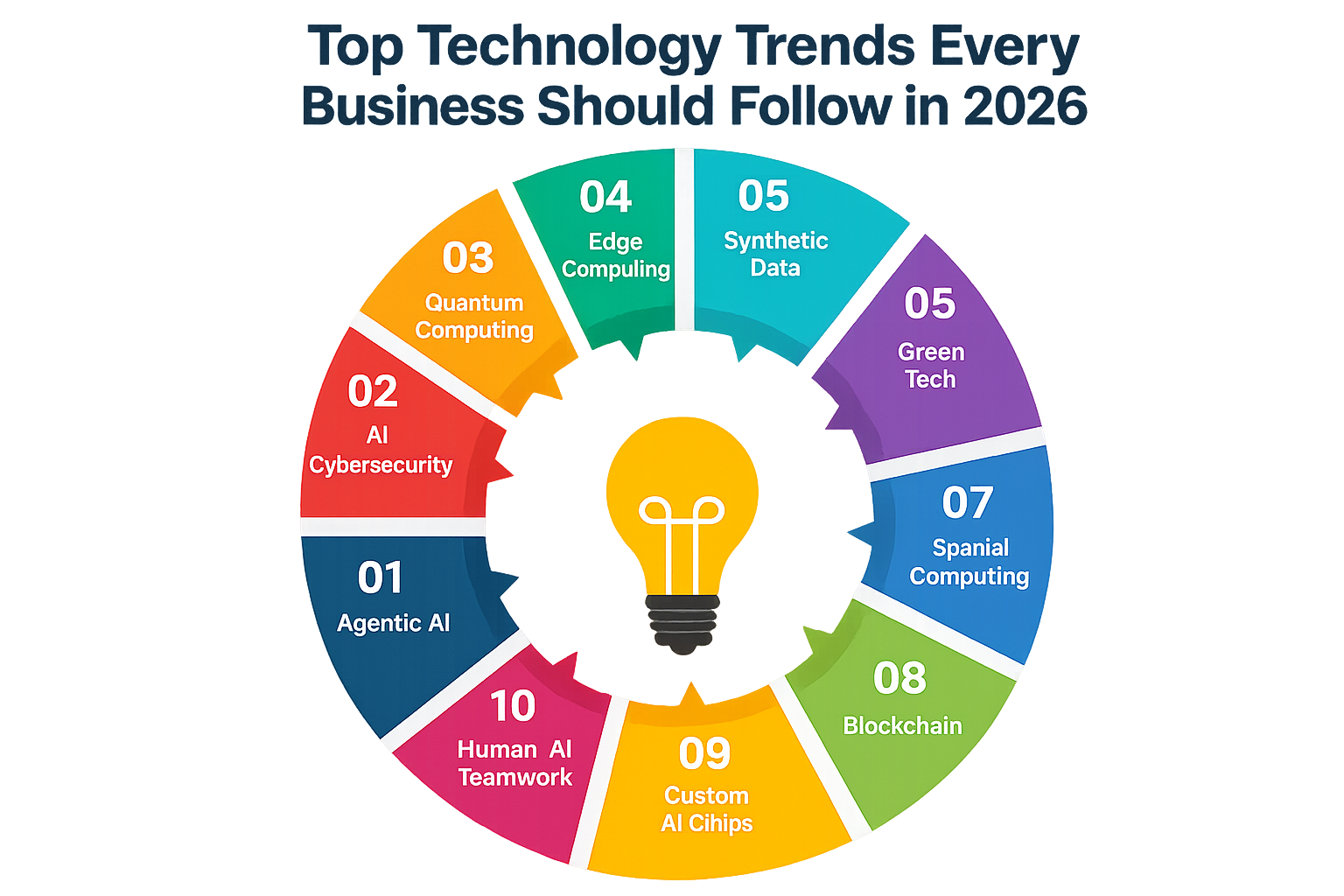
1. Agentic AI
AI that completes tasks on its own, not just answers.
Example: Automatically follows up with unpaid clients.
Why it matters: Saves time on repetitive work.
Action: Automate one daily task.
It reduces manual effort across departments. It also helps scale operations without adding extra staff.
2. AI Cybersecurity
AI that detects and blocks cyberattacks in real time.
Example: Stops unusual login activity instantly.
Why it matters: Faster protection than humans alone.
Action: Upgrade to AI-based security tools.
It helps detect threats before damage happens. It also improves overall system trust and reliability.
3. Quantum Computing
Super-advanced computing for complex problems.
Example: Instantly finds best delivery routes for thousands of packages.
Why it matters: Solves problems that normal computers can’t.
Action: Identify complex business problems for future use.
It will revolutionize industries like logistics and finance. Early awareness helps future readiness.
4. Edge Computing
Processes data directly on devices, not in the cloud.
Example: A security camera detects threats instantly.
Why it matters: Faster real-time decisions.
Action: Check if your systems need low-latency upgrades.
It reduces delay and improves response time. It is essential for real-time applications.
5. Synthetic Data
Artificial data is used to train AI safely.
Example: Fake patient records for medical AI training.
Why it matters: Protects privacy and meets regulations.
Action: Explore synthetic data tools for AI training.
It helps businesses avoid legal and privacy risks. It also improves AI model quality.
6. Green Tech
Technology that reduces energy use and carbon impact.
Example: Running computing tasks when energy is cleaner.
Why it matters: Saves cost and meets sustainability rules.
Action: Track and reduce IT energy usage.
It improves brand reputation and compliance. It also reduces long-term operational costs.
7. Spatial Computing
Blends digital content with the real world.
Example: AR glasses show repair steps on machines.
Why it matters: Improves training and field work.
Action: Explore AR/VR for training or support.
It enhances user experience in real environments. It also reduces training time and errors.
8. Blockchain
Secure shared record system that can’t be changed.
Example: Tracks food supply from farm to store.
Why it matters: Builds trust and reduces fraud.
Action: Use it for supply chain or payments.
It increases transparency across systems. It also reduces dependency on intermediaries.
9. Custom AI Chips
Special chips built to run AI faster and cheaper.
Example: Faster AI processing with lower cost.
Why it matters: Reduces AI operating expenses.
Action: Check cost savings for AI workloads.
It improves the speed and scalability of AI systems. It also reduces infrastructure costs significantly.
10. Human-AI Teamwork
Humans and AI are working together in workflows.
Example: AI writes medical notes, doctor reviews them.
Why it matters: Increases productivity and efficiency.
Action: Redesign roles to include AI assistance.
It improves decision-making quality. It also ensures AI is used effectively in real work.
How These Top Technology Trends Connect to Each Other
The top technology trends of 2026 are interconnected and strengthen each other.
Agentic AI becomes faster and more efficient with Custom AI Chips, while Edge Computing enables real-time decisions in critical environments. Synthetic Data improves AI training across all systems, and Green Tech helps reduce energy impact.
At the center, Human-AI collaboration ensures all technologies deliver real business value.
Which Industries Will Be Most Impacted by These Top Technology Trends
Every industry will feel the effect of these top technology trends — but some will be transformed more dramatically than others.
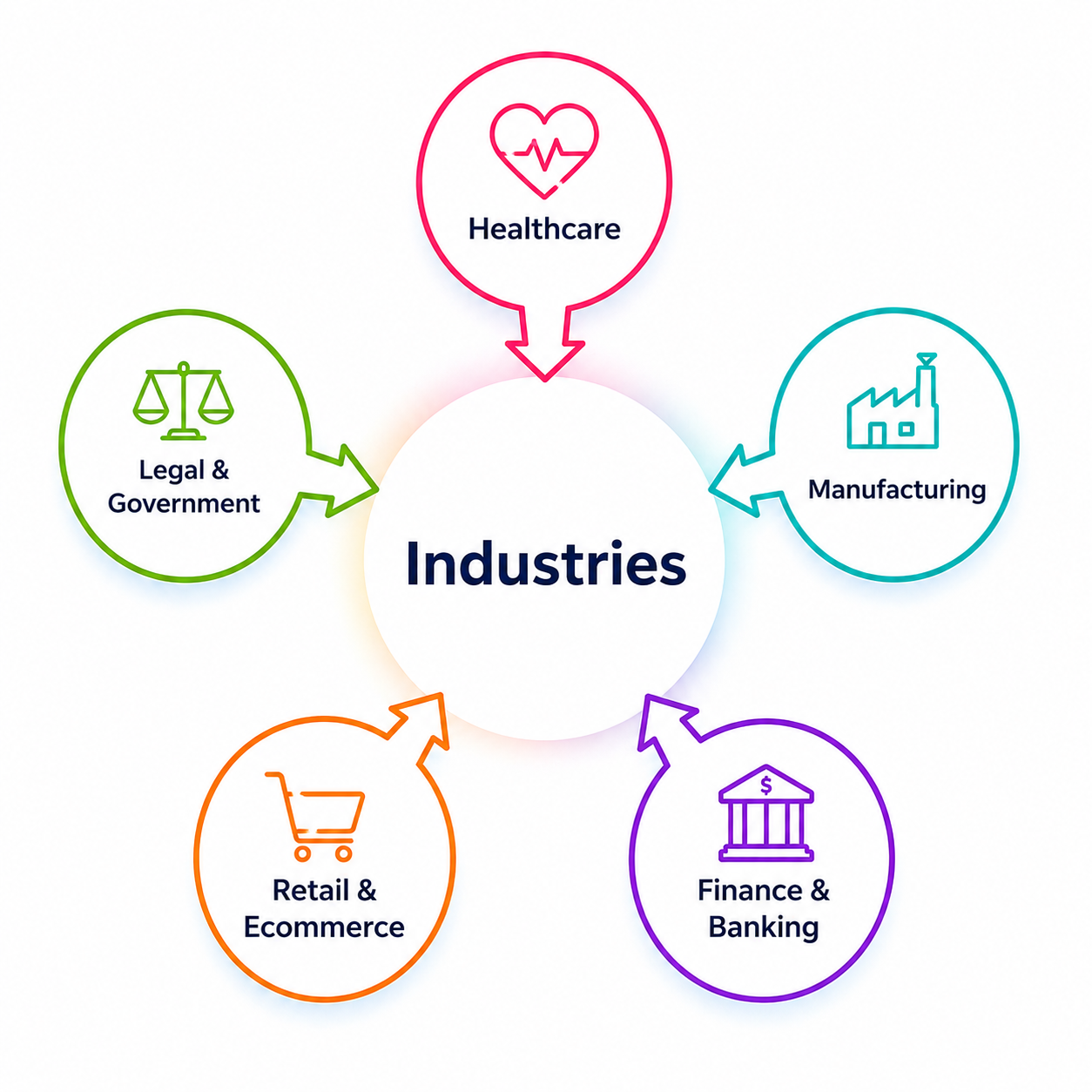
Healthcare
Healthcare will be reshaped by Synthetic Data, Agentic AI, and Spatial Computing. Patient records stay private, routine admin gets automated, and surgical training moves into immersive simulation. Doctors spend more time with patients and less time on paperwork.
Manufacturing
Manufacturing will be driven by Edge Computing, Spatial Computing, and Custom AI Chips. Factories become smarter, self-monitoring, and faster to repair. Digital twins allow engineers to simulate problems and solutions before touching a single machine.
Finance and Banking
Finance and Banking will be redefined by AI, Cybersecurity, Blockchain, and Quantum Computing. Fraud is detected in milliseconds. Cross-border settlements that took days happen in seconds. Risk models become more accurate than ever before.
Retail and E-commerce
Retail and E-commerce will be transformed by Agentic AI and Edge Computing. Inventory management, pricing, customer communication, and logistics become largely automated. Stores become smarter and more responsive in real time.
Legal and Government
Legal and Government will rely heavily on Synthetic Data and Blockchain. Contracts become self-enforcing. Records become tamper-proof. Sensitive data gets used for AI development without violating citizen privacy.
No matter what industry you are in, at least three or four of these top technology trends are directly relevant to your business today.
Common Mistakes Businesses Make When Adopting Top Technology Trends
Understanding top technology trends is one thing. Implementing them without making costly mistakes is another. Here are the most common errors businesses make — and how to avoid them.
Buying technology without a clear problem to solve.
Many businesses invest in AI or blockchain because it sounds impressive, not because it solves a specific, measurable problem. Always start with the problem, not the technology.
Trying to do everything at once.
Spreading budget and attention across five new technology initiatives at the same time almost guarantees that none of them will succeed. Pick one. Do it properly. Measure results. Then move to the next.
Ignoring the human side.
Technology projects fail most often not because of the technology, but because the people using it weren’t trained, weren’t involved, or weren’t convinced. Change management is as important as the technology itself.
Choosing tools based on brand names alone.
The biggest vendor is not always the right fit for your business size, industry, or use case. Evaluate tools based on your specific needs, not on marketing budgets.
Not measuring results.
If you cannot measure whether a technology initiative is working, you cannot improve it — or justify continuing to invest in it. Define success metrics before you start, not after.
Avoiding these mistakes will save your business significant time, money, and frustration when adopting the top technology trends in this guide.
How to Build Your Technology Roadmap Around These Top Technology Trends
A technology roadmap is a simple plan that defines what technologies you will adopt, in what order, and within what timeframe. It doesn’t need to be complex — it just needs clear direction.
Identify your biggest operational challenges
Start by analyzing where your business is struggling the most. Focus on areas where your team spends excessive time, where costs are high, or where errors frequently occur. Your adoption of new technology trends should directly solve these core problems first.
Match pain points to trends.
Look at the 10 top technology trends in this guide and identify which ones directly address your pain points. You will likely find two or three clear matches.
Prioritize by impact and feasibility.
Not every trend is equally easy to adopt. Agentic AI and AI Cybersecurity can be implemented relatively quickly. Quantum Computing requires longer preparation. Rank your priorities by both potential impact and how realistic adoption is in the next 12 months.
Set a 90-day pilot goal.
For your top priority, define a small, contained pilot. A specific problem, a specific tool, a specific success metric, and a 90-day timeline. Small pilots produce evidence. Evidence produces confidence. Confidence produces investment.
Review quarterly.
The top technology trends landscape is moving fast. Review your roadmap every three months, not annually. What worked? What didn’t? What new developments should change your priorities?
A good technology roadmap doesn’t require perfection. It requires direction, commitment, and a willingness to learn as you go.
FAQ
Q1. What are the top technology trends in 2026?
They include Agentic AI, AI Cybersecurity, Quantum Computing, Edge Computing, Synthetic Data, Green Tech, Spatial Computing, Blockchain, Custom AI Chips, and Human-AI Teamwork. These are shaping modern business growth.
Q2. Which trend should small businesses start with?
Agentic AI is the best starting point because it automates daily tasks like emails, scheduling, and data entry at low cost.
Q3. Are these trends only for big companies?
No. Small and mid-sized businesses benefit greatly by reducing costs and improving efficiency with these technologies.
Q4. How much does it cost to adopt them?
Costs vary. Many AI and cybersecurity tools are subscription-based, while advanced areas like quantum computing need higher investment. Starting small is recommended.
Q5. Do I need a technical team?
Not always. Many tools like Agentic AI and AI Cybersecurity are no-code or plug-and-play. Advanced technologies may need expert support.
Q6. What is the risk of ignoring these trends?
Businesses risk falling behind competitors in speed, efficiency, and customer experience.
Q7. How do I choose the right trend?
Pick based on your main problem—automation (AI), security (cybersecurity), or performance (edge computing).
Conclusion
The top technology trends of 2026 are real shifts, not just buzzwords, shaping how businesses operate and grow. You don’t need to adopt everything at once—start with what solves your biggest challenge.
Use Agentic AI for repetitive work, AI Cybersecurity for data protection, Custom AI Chips to reduce AI costs, Synthetic Data for safer data handling, and Human-AI Teamwork to improve collaboration with AI. Winning businesses in 2026 are not those using the most technology, but those adopting the right trends at the right time.