Introduction
Most business owners think web design is about making a website look good.
That is the point most businesses miss — and it costs them customers every single day.
Web design is not about beauty. It is about results. It is about building a website that attracts the right visitors, builds trust instantly, and converts those visitors into paying customers.
This guide shares the most important web design tips every business owner needs — not to become a designer, but to make sure their website is genuinely working for their business every day.
What Web Design Is Really About
Web design is more than creating a visually appealing website. It’s about helping visitors understand your business, find information easily, and take action.
A well-designed website builds trust, improves user experience, and supports business growth. Every element—from the layout to the call-to-action buttons—plays a role in turning visitors into customers.
The real question isn’t “Does my website look good?” but “Is my website helping my business grow?”
Why Most Businesses Miss the Point of Web Design
Most businesses miss the real point of web design for three simple reasons.
They focus on aesthetics over function.
A beautiful website that confuses visitors or loads slowly is a failure — regardless of how impressive it looks. Function always comes before form in effective web design.
They build a website once and forget it.
A website is not a one-time project. It is a living part of your business that needs regular updates and attention. Businesses that never touch their website again are leaving money on the table every single day.
They do not measure results.
Most business owners have no idea how many people visit their website or what percentage of visitors take action. Without measuring results, you cannot improve — and you cannot know whether your web design is working or failing.
The Most Important Pages Every Business Website Must Have
A successful business website is more than just a beautiful design. It should provide visitors with the information they need while guiding them toward becoming customers. Every business website should include essential pages that build trust, improve user experience, and support business growth.
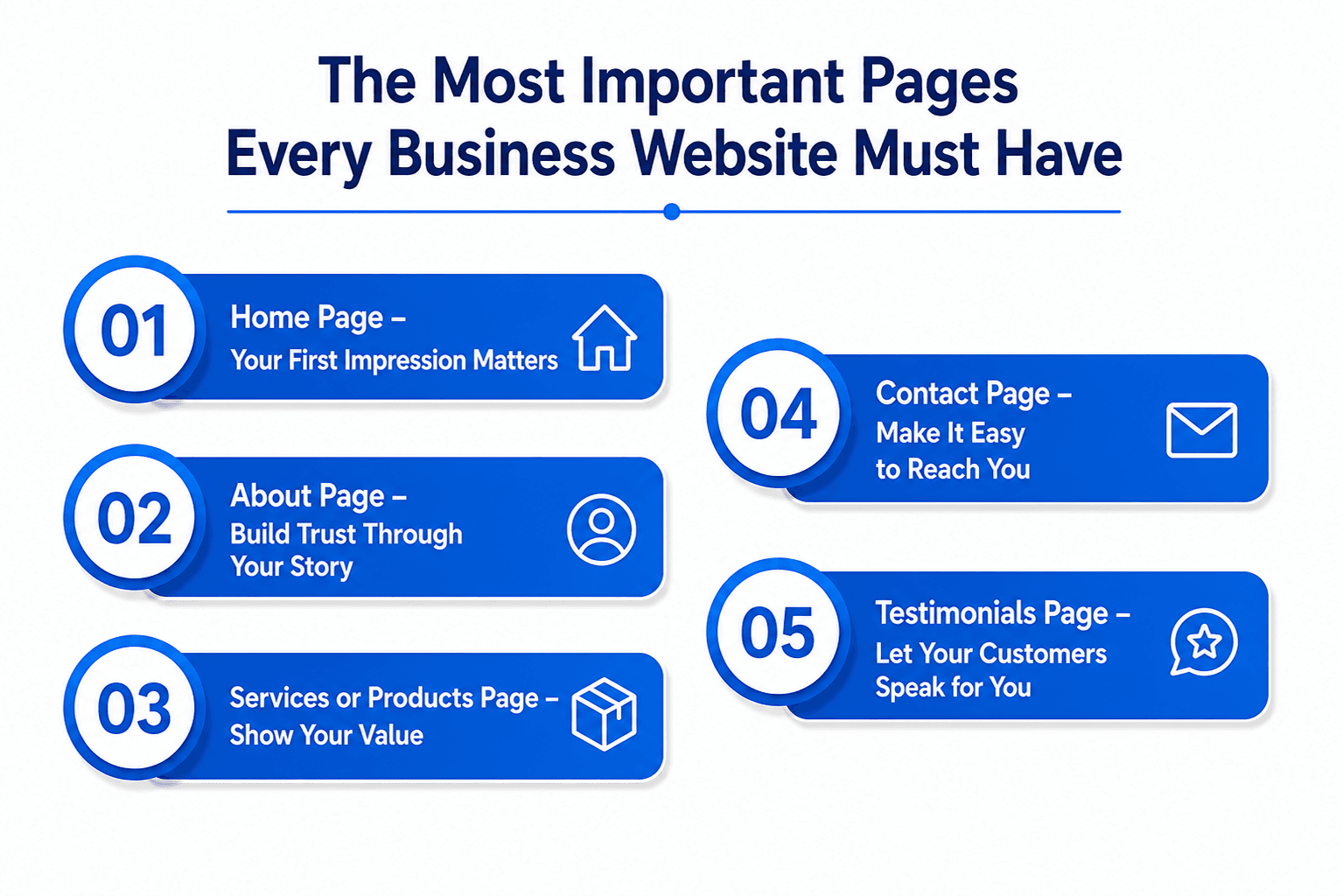
1. Home Page – Your First Impression Matters
The home page is where most visitors land first. It must immediately communicate who you are, what you do, and what action visitors should take next. A clear and well-structured home page helps capture attention and reduce bounce rates.
2. About Page – Build Trust Through Your Story
The About page tells the story of your business, including who you are, why you started, and what makes your company unique. A genuine and informative About page helps visitors connect with your brand and builds credibility.
3. Services or Products Page – Show Your Value
Your Services or Products page should clearly explain what you offer and how it benefits customers. Focus on solving customer problems and highlighting the value they receive rather than simply listing features.
4. Contact Page – Make It Easy to Reach You
Potential customers should never struggle to contact your business. Include your phone number, email address, contact form, business location, and other relevant contact information to encourage inquiries.
5. Testimonials Page – Let Your Customers Speak for You
Customer reviews and testimonials are powerful trust-building tools. Positive feedback from real customers helps reassure potential clients and increases confidence in your products or services.
Why These Pages Matter
These pages form the foundation of a successful business website. Together, they help visitors understand your business, build trust in your brand, and encourage them to take action. Whether you’re creating a new website or improving an existing one, ensuring these essential pages are present can significantly improve user experience and business results.
Web Design Tips for a Website That Actually Works
These are the most important web design tips every business owner needs to apply right now.
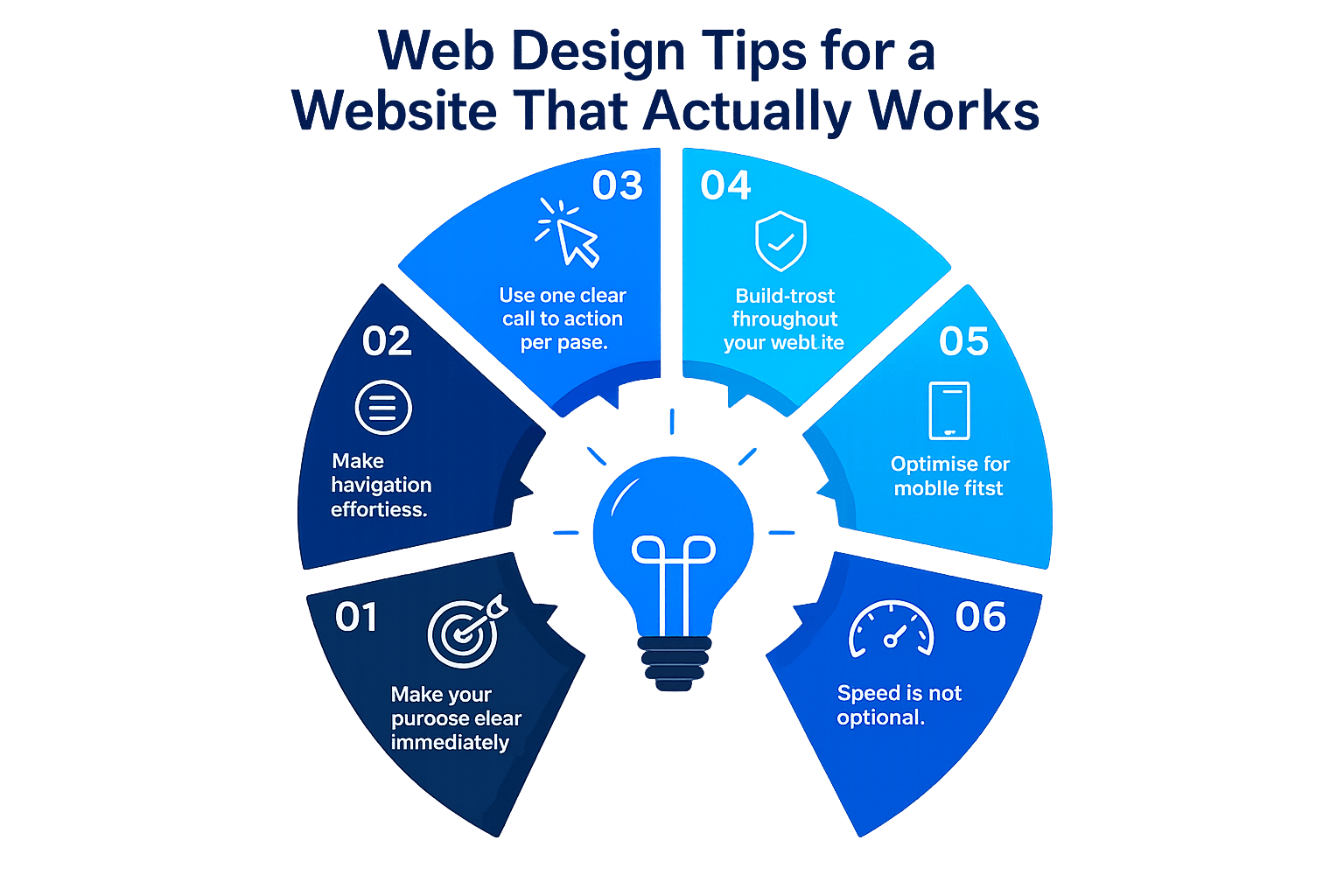
Make your purpose clear immediately.
Your homepage headline should be clear, specific, and benefit-focused — telling visitors exactly who you are and what you do within seconds of arriving.
Design for your visitor, not yourself.
Every design decision should be made with your customer’s needs and behaviour in mind — not your own personal preferences or tastes.
Make navigation effortless.
Limit your main navigation to five to seven items maximum. Label each one clearly so visitors can find what they need within two clicks without any confusion or frustration.
Use one clear call to action per page.
Every page should have one primary action you want visitors to take — call us, book a consultation, or get a quote. Make that action prominent and easy to find.
Build trust throughout your website.
Place customer reviews, clear contact information, professional photography, and security badges strategically across your website to build visitor confidence consistently.
Optimise for mobile first.
More than half of all website visits happen on mobile phones. Your website must load fast, navigate easily, and display perfectly on every screen size without compromise.
Speed is not optional.
If your website takes more than three seconds to load, you are losing visitors before they see your content. Compress images, use reliable hosting, and test your speed regularly.
How Web Design Affects Your Search Engine Rankings
Web design and search engine optimisation are directly connected. Google does not just rank websites based on keywords — it ranks them based on the experience they provide to visitors.
Page speed is a ranking factor.
Google has confirmed that slow websites rank lower in search results. Every improvement you make to your website’s loading speed directly improves your search visibility and organic traffic.
Mobile friendliness is a ranking factor.
Google primarily uses the mobile version of your website to determine its search rankings. A website that does not work well on mobile will rank lower, meaning fewer potential customers will ever find you through search.
Time on site affects rankings.
When visitors stay on your website longer because it is easy to use and full of useful content, it signals to Google that your website is valuable, improving your rankings over time consistently.
Bounce rate affects rankings.
If visitors land on your website and leave immediately because it loads slowly or looks poor, your bounce rate rises. A high bounce rate tells Google your website is not providing value — pushing your rankings down further.
Site structure affects rankings.
Clear logical navigation and well-organised pages make it easier for Google to crawl and understand your website — improving how well it indexes and ranks your content in search results.
How to Choose the Right Web Designer for Your Business
Choosing the right web designer is one of the most important decisions you will make for your online presence. The wrong choice wastes money and creates problems. The right choice transforms how your business performs online.
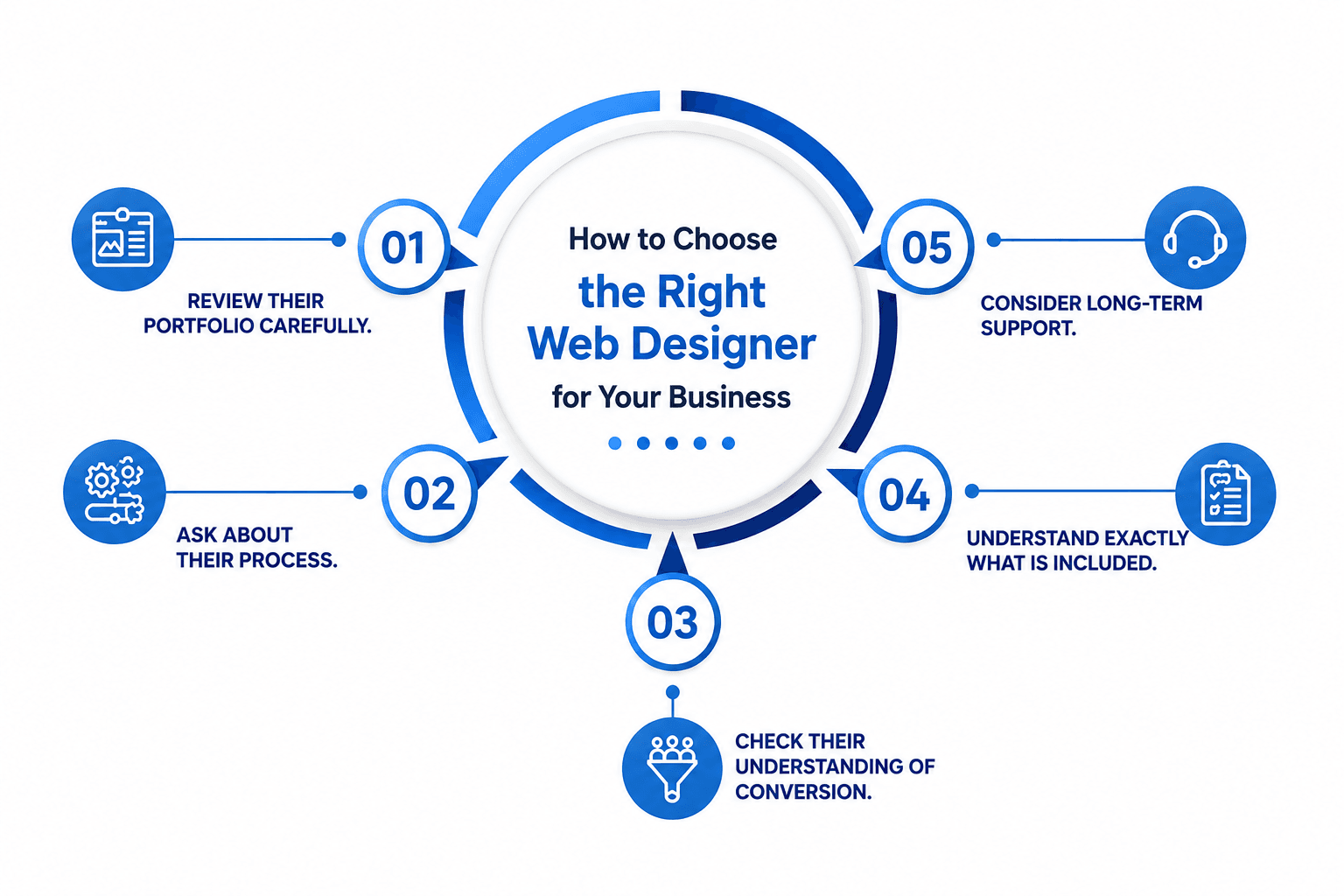
Review their portfolio carefully.
Look at websites they have previously designed. Do they look professional and modern? Are they easy to navigate? Do they work well on mobile? A portfolio tells you far more than any sales pitch ever will.
Ask about their process.
How do they learn about your business and customers? How many design revisions are included? How long will the project take? Clear professional processes indicate a reliable and experienced designer.
Check their understanding of conversion.
Good web designers understand that a website must not just look good — it must convert visitors into customers. Ask specifically how they approach conversion in their design process before committing.
Understand exactly what is included.
Some web designers only handle the visual design. Others include development, content, SEO setup, and ongoing maintenance. Know precisely what you are paying for before signing any agreement.
Consider long-term support.
Your website will need updates and maintenance long after it launches. Choose a web designer who offers reliable ongoing support and treats your website as a long-term investment rather than a one-time project.
Common Web Design Problems and How to Fix Them
Visitors leave immediately without taking action.
Your homepage is not clearly communicating your value, or your call to action is not visible enough.
Solution. Rewrite your homepage headline to be specific and benefit-focused. Add a clear, visible call to action above the fold.
The website looks great on desktop but terrible on mobile.
Most business owners design their website on a desktop — but most visitors view it on a phone.
Solution. Review your website on multiple mobile devices and fix every issue. Design for the smallest screen first and scale up.
Visitors cannot find contact information easily.
Many business websites bury contact details on a hidden page — creating friction and costing businesses enquiries every day.
Solution. Put your phone number and email in the header of every page. Include a contact form on your homepage and make reaching you effortless.
The website loads too slowly.
Large images, cheap hosting, and unnecessary plugins can significantly reduce your website’s performance. Slow-loading websites frustrate visitors, increase bounce rates, and can negatively impact search engine rankings.
Solution:
Compress every image before uploading, invest in reliable hosting, and remove unnecessary plugins that consume resources. Regularly monitor your website’s performance using Google PageSpeed Insights and track technical SEO issues, indexing status, and overall search performance with Google Search Console. These tools help identify problems early and ensure your website remains fast, user-friendly, and optimized for better rankings.
The website has no social proof.
Visitors with no evidence of happy customers have no reason to trust your business — regardless of design quality.
Solution. Add genuine customer reviews and testimonials with names and specific details to your homepage and services page immediately.
FAQ
1. Why is my website getting traffic but not generating leads?
Improve calls-to-action, user experience, and conversion-focused design elements.
2. Why do visitors leave my website quickly?
Simplify navigation, improve loading speed, and communicate your value clearly.
3. Why does my website look good but fail to deliver results?
Focus on business goals and user needs instead of visual appearance alone.
4. Why are customers struggling to find information on my website?
Organize content better and create a clear navigation structure.
5. Why am I not receiving inquiries through my website?
Add visible contact forms, CTA buttons, and multiple communication options.
6. Why don’t visitors trust my website?
Use professional design, customer testimonials, and trust-building elements.
7. Why is my website performing poorly on mobile devices?
Implement a fully responsive design for all screen sizes.
8. Why is a slow website affecting my business?
Optimize website speed to improve user experience and reduce bounce rates.
9. Why isn’t my website ranking well on Google?
Build an SEO-friendly website with proper structure and optimized content.
10. Why are visitors not taking action on my website?
Create a clear user journey with strong calls-to-action and conversion-focused design.
Final Thought
Web design is not about making your website look impressive. It is about making it work for your business, your customers, and your growth.
Apply these web design tips consistently. Make your purpose clear. Design for your customers. Build trust on every page. Optimize for mobile devices and website speed. Choose the right web design partner and measure your results regularly.
A website that works hard is one of the most powerful tools your business has. Make sure yours is doing its job every single day.
If you’re looking to create a professional, user-friendly, and conversion-focused website, partnering with the best website design company in Coimbatore can help you build a website that not only looks great but also drives real business results.