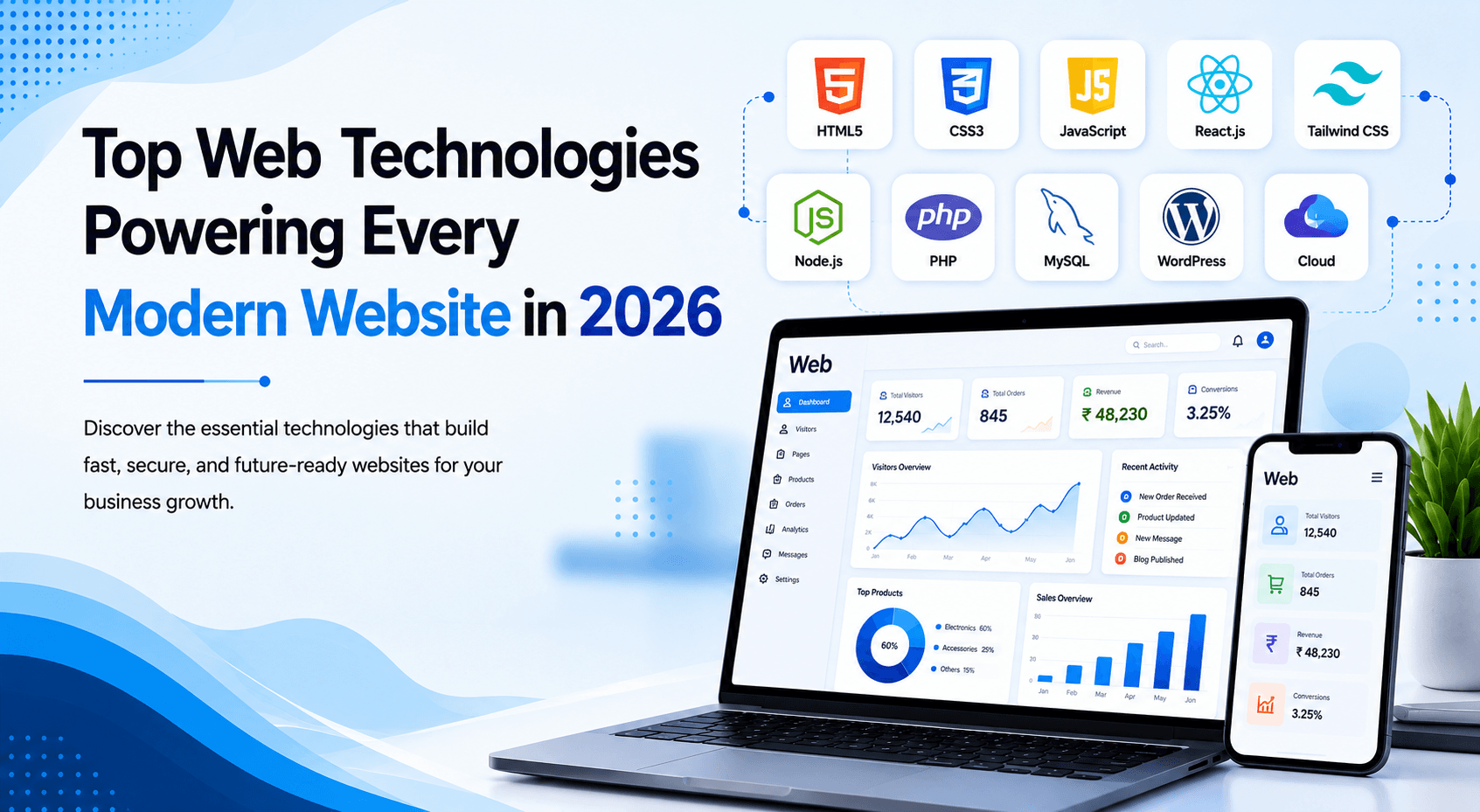
Web Technologies: The Foundation of Every Modern Website in 2026
Let me ask you something simple.
When was the last time you waited more than 5 seconds for a website to load?
You probably clicked away, right?
That’s exactly what your customers do too.
And most of the time, the problem is not the design. It is the technology behind the website.
So in this blog, I am going to break down the key technologies that go into building a modern website — in plain, simple language. No tech jargon. No confusing terms. Just what you actually need to know.
Why Does Technology Even Matter?
Think of your website like a car.
The design is the colour and body style — it catches your eye. But the technology is the engine — it actually makes things work.
You can have the most beautiful car in the world. But if the engine is weak, it will break down on the road.
Same with websites.
The right technology makes your website:
- Load fast on any device.
- Show up on Google
- Stay safe from hackers.
- Easy for you to update
- Ready to grow with your business
The wrong technology leads to:
- Pages that take forever to load
- Website crashes during busy periods
- Difficult to make simple changes
- Poor Google ranking
- Expensive fixes later
Now, let us look at what technologies actually go into a modern website.
Key Technologies Used in Modern Websites
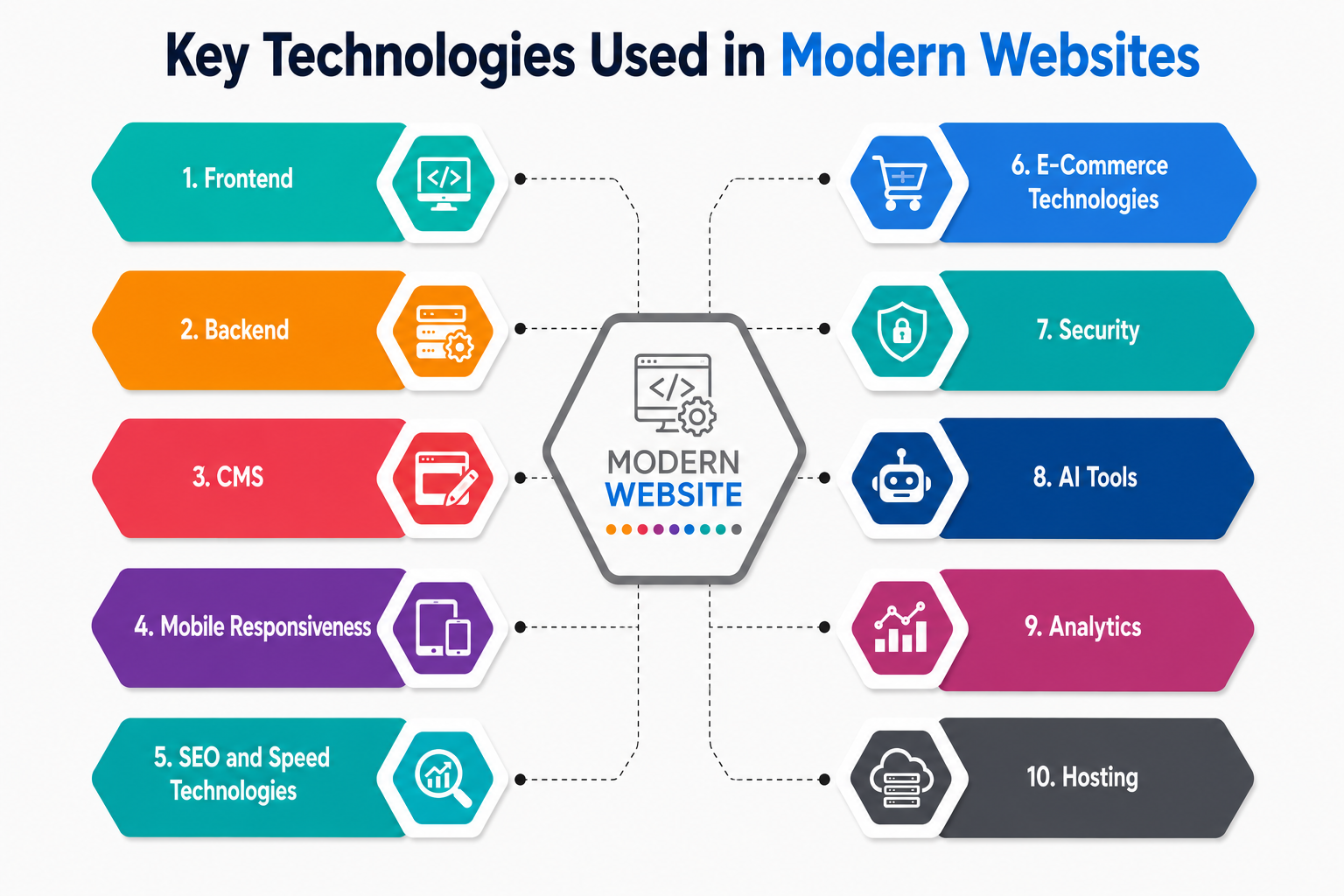
1. Frontend — The Part You Actually See
When you open a website and see text, images, buttons, and menus — that is the frontend.
The common technologies used here are:
- HTML5 — Gives the page its structure. Think of it as the skeleton.
- CSS3 — Makes it look good. Colours, fonts, spacing — all CSS.
- JavaScript — Makes things move and interact. Dropdown menus, pop-ups, sliders.
- React.js — Used by companies like Facebook and Instagram for fast, smooth pages.
- Tailwind CSS — Helps designers build clean, responsive layouts quickly.
In simple terms, the frontend is what your visitor sees and clicks on. It must look good and work fast.
2. Backend — The Engine Behind the Scenes
Your visitor never sees this part. But it runs everything.
When someone fills a contact form on your website, the backend processes it. When someone places an order, the backend saves it. When you log in to update your website, the backend handles that too.
Common backend technologies:
- PHP – Powers over 70% of all websites in the world, including WordPress.
- Node.js — Great for websites that need to handle thousands of users at once.
- Python — Used for smart, data-driven websites and AI features.
- Laravel — A cleaner, more secure way to build with PHP.
- MySQL — The database that stores all your website data.
In simple terms: Backend is the brain of your website. It handles all the logic and data.
3. CMS — So You Can Update Without Calling a Developer
CMS stands for Content Management System.
It is basically the control panel of your website.
With a good CMS, you can:
- Change your homepage text.
- Add a new blog post
- Upload a new product photo.
- Update your pricing
All by yourself. No technical knowledge needed.
Popular CMS platforms:
- WordPress — Used by over 43% of all websites globally. Most flexible.
- Webflow — Great for beautiful, design-heavy websites.
- Shopify — Built specifically for online stores.
- Wix / Squarespace — Simple, beginner-friendly options.
- Custom CMS — Built from scratch for specific business needs.
In simple terms: CMS gives you the freedom to manage your own website easily.
4. Mobile Responsiveness — Because Everyone Is on Their Phone
Here is a fact most people do not realise.
Over 65% of website visits in 2026 happen on mobile phones.
So if your website does not look good on a phone, you are losing more than half of your visitors.
Technologies that make websites mobile-friendly:
- Responsive Design — The website automatically adjusts to fit any screen size.
- Bootstrap — A popular toolkit that helps build mobile-first websites quickly.
- Progressive Web Apps (PWA) — Websites that feel and work like a mobile app.
- AMP — Super fast loading pages specifically for mobile users.
In simple terms: Your website must work perfectly on a phone. No excuses in 2026.
5. SEO and Speed Technologies — So Google Can Find You
A website nobody visits is just an expensive business card.
Speed and SEO technologies make sure Google notices your web technologies site and shows it to the right people.
Key tools used:
- Core Web Vitals — Google’s checklist for speed, stability, and responsiveness.
- Lazy Loading — Images load only when someone scrolls to them, making the page faster.
- CDN (Content Delivery Network) — Delivers your website from a server near the visitor, so it loads faster.
- Schema Markup — Gives Google extra information about your business, products, and services.
- SSL (HTTPS) — The little padlock in the browser. It tells Google your website is safe.
In simple terms: These technologies help Google trust your website and show it to more people.
6. E-Commerce Technologies — For Selling Online
If you are selling products or services online, you need more than just a nice-looking page.
You need technology that handles payments, inventory, and customer data securely.
Common e-commerce technologies:
- Shopify — The most popular platform for online stores. Easy to set up and manage.
- WooCommerce — WordPress-based. Very flexible and customizable.
- Razorpay / Stripe / PayU — Payment gateways that process transactions safely.
- Inventory Systems — Automatically track stock so you never oversell.
- Multi-language and multi-currency support — For reaching customers across India and beyond.
In simple terms: E-commerce technology makes buying from your website safe, smooth, and simple.
7. Security — Protecting Your Business and Your Customers
Website security is not optional. It is essential.
A hacked web technologies site damages your reputation, loses customer data, and can take your business offline.
Key security technologies:
- SSL/TLS Encryption — All data sent between your visitor and your website is encrypted.
- Firewall — Blocks suspicious and harmful traffic before it reaches your site.
- Two-Factor Authentication — Adds an extra verification step for logins.
- Automatic Backups — If anything goes wrong, your website can be restored quickly.
- Malware Scanning — Regularly checks your website for threats and removes them.
In simple terms: Security technology keeps your web technologies site and your customers safe every single day.
8. AI Tools — Smart Features That Work for You
Artificial intelligence is no longer just for big tech companies.
Today, even small business web technologies use AI to improve customer experience and save time.
How AI is being used in websites right now:
- AI Chatbots — Answer customer questions instantly, even at 2am.
- Personalisation — Show different content to different visitors based on their behaviour.
- Smart Search — Helps visitors find exactly what they are looking for faster.
- AI-Powered SEO — Automatically suggests keywords and content improvements.
- Automated Emails — Send the right message to the right customer at the right time.
In simple terms: AI tools make your website smarter and more helpful without extra effort from you.
9. Analytics — So You Know What Is Working
You cannot grow what you cannot measure.
Analytics tools tell you exactly what is happening on your website — who visited, what they clicked, where they dropped off, and what made them convert.
Common analytics tools integrated into websites:
- Google Analytics 4 — Tracks all visitor activity on your website.
- Google Search Console — Shows how your website is performing on Google search.
- Meta Pixel — Tracks visitors who came from your Facebook or Instagram ads.
- Hotjar — Shows heatmaps of where people click and scroll on your pages.
- CRM Integration — Connects website leads directly to your sales team.
In simple terms, Analytics tools show you exactly where to improve so you get more results from your website.
10. Hosting — Where Your Website Actually Lives
Every website lives on a server somewhere.
The quality of that server directly affects how fast and reliable your website is.
Modern hosting options:
- Cloud Hosting (AWS, Google Cloud) — Fast, scalable, and always reliable.
- Managed WordPress Hosting — Optimised specifically for WordPress speed.
- VPS Hosting — Dedicated resources for websites that are growing fast.
- Cloudflare — Improves speed and adds an extra layer of security globally.
- Automated Backups — Your website data is protected automatically every day.
In simple terms: Good hosting means your website is always fast, always online, and never lets your customers down.
Questions to Ask Before You Hire a Web Design Company
Now that you know what technologies matter, here is what to ask any web technologies design company before you sign anything:
- What CMS will you build my website on?
- Will it work perfectly on mobile phones?
- Is the website built to rank on Google?
- What security is included?
- Which hosting do you recommend and why?
- Can I update my own content after launch?
- Do you set up analytics from day one?
- Do you offer support after the website goes live?
A good company will answer these confidently and clearly. If they hesitate or get vague — that tells you something.
Common Mistakes Most Business Owners Make
- Going with the cheapest quote without checking what is included
- Not asking about mobile responsiveness.
- Skipping security setup to save money
- Not integrating analytics at launch.
- Choosing unreliable hosting that causes downtime
- Not asking who owns the web technologies files after launch.
These mistakes are expensive. Knowing about them up front saves you a lot of trouble later.
Conclusion
Your web technologies is more than just an online presence—it’s a business asset that should generate leads, build trust, and support long-term growth.
As a leading website design company in Coimbatore, we use modern technologies to create high-performing, future-ready web technologies that help businesses succeed online.
Ready to build a website that delivers results? Let’s talk.